
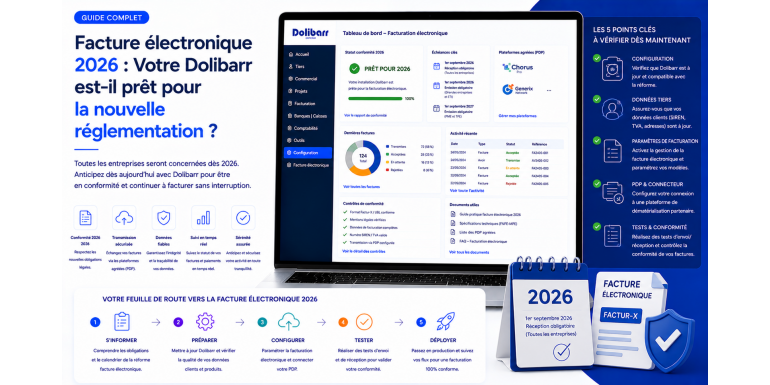
The generalization of electronic invoicing in France is one of the most structural reforms for companies of the decade. Announced and postponed several times, it now enters progressive application starting September 2026, with a precise calendar according to company size. All companies subject to VAT will have to issue, receive and transmit their invoices in structured electronic form, via platforms approved by the administration. This reform deeply transforms commercial and accounting mechanics, and it requires every company using Dolibarr to verify that its tool is ready to meet the new obligations.
For Dolibarr users, the good news is that the open source platform is sufficiently open and modular to adapt to the reform. Still, you must properly prepare your instance, configure the right modules, choose the right dematerialization platform partner, train teams and anticipate operational impacts. In this comprehensive guide, NEXT GESTION details the 2026 obligations, the technical solutions available in the Dolibarr ecosystem and the concrete steps to make your instance fully compliant. We also share feedback from our first clients in pilot phase, and frequent pitfalls to avoid.
Table of Contents
- Understanding the 2026 Electronic Invoice Reform
- The Implementation Calendar by Company Size
- The New Actors: PPF, PDP and OD
- The Imposed Formats: Factur-X, UBL, CII
- E-reporting: What to Transmit to the Administration
- What Dolibarr Offers Standard for Electronic Invoicing
- Dolistore Complementary Modules for Compliance
- Choosing a Dolibarr-Partner PDP
- Configuring Dolibarr for Electronic Invoicing
- Preparing Third Party Records and Catalog
- Adapting Your Invoice Templates
- Testing Inbound and Outbound Flows
- Training Teams and Supporting Change
- Anticipating Accounting and Organizational Impacts
- Best Practices for Successful Transition
- Frequent Errors and Risks to Anticipate
- NEXT GESTION Support for Electronic Invoicing
- FAQ: Frequently Asked Questions About Electronic Invoicing 2026
1. Understanding the 2026 Electronic Invoice Reform
The electronic invoicing reform aims at several simultaneous objectives. The first is the fight against VAT fraud, which represents several billion euros per year in France. By requiring companies to transmit their invoices via controlled platforms, the tax administration has near real-time visibility on transactions and can detect anomalies much faster. The second objective is administrative simplification for companies, with eventual pre-filling of VAT declarations. The third is the modernization of the French economic fabric through digitalization of commercial exchanges.
Concretely, the reform rests on three indivisible pillars. The first is the obligation to receive electronic invoices, which applies to all companies subject to VAT from the first wave of September 2026. The second is the obligation to issue electronic invoices, which follows a progressive calendar according to company size. The third is e-reporting, which consists of transmitting to the administration certain information on B2C transactions, international operations and payment statuses.
The electronic invoice within the meaning of the reform is not a simple PDF sent by email. It is a structured file, machine-readable, containing standardized data in a format defined by regulation. This structuring allows automation of processing on the sender and recipient sides, and automatic extraction of fiscal data by the administration.
This French reform fits into a broader European movement, with the ViDA directive for VAT in the Digital Age, which aims to progressively harmonize requirements across the European Union. Companies that export to other European countries must therefore anticipate not only French compliance but also evolutions to come in their target markets.
2. The Implementation Calendar by Company Size
The reform application calendar distinguishes several categories of companies with differentiated dates.
From September 1, 2026, all companies subject to VAT, regardless of size, must be able to receive electronic invoices. This obligation is universal and admits no exception. Concretely, your Dolibarr must be able to receive and process electronic invoices reaching you via approved platforms.
On the same date of September 1, 2026, large companies and mid-sized companies must issue electronic invoices. Large companies are defined as those employing more than five thousand employees or generating more than one billion five hundred million euros in revenue. Mid-sized companies are those employing between two hundred fifty and five thousand employees or generating between fifty million and one billion five hundred million euros in revenue.
From September 1, 2027, SMEs and micro-enterprises must issue electronic invoices. This second wave concerns the majority of the French economic fabric, about four million companies.
Beyond issuance, the e-reporting obligation follows a similar calendar. Companies must transmit to the administration information on their transactions with individuals, their exports outside the European Union and their payment statuses.
These dates may still evolve depending on platform maturity and feedback from pilot phases. It nevertheless remains essential to anticipate, because technical compliance of a Dolibarr typically takes between two and six months depending on instance complexity.
3. The New Actors: PPF, PDP and OD
The reform introduces new actors in the invoicing ecosystem, which it is essential to understand to properly prepare your Dolibarr.
The Public Invoicing Portal, or PPF, is the public platform managed by the administration. Originally planned to be the main channel of the reform, its role has been redefined after successive postponements. It becomes a central directory of companies and a recipient of certain e-reporting information. For operational invoice transmission, companies will mainly go through Partner Dematerialization Platforms.
Partner Dematerialization Platforms, or PDPs, are private operators approved by the administration. They ensure the technical transmission of invoices between sender and recipient, conversion between formats, regulatory compliance, legal archiving and transmission to the PPF of information required for e-reporting. Companies choose their PDP as they choose their bank or telecom operator. Several dozen PDPs are in approval or already approved.
Dematerialization Operators, or ODs, are non-approved providers who can intervene as subcontractors of a PDP or as a complement. They do not have the right to transmit directly to the PPF but can route invoices via a partner PDP.
For a Dolibarr user, choosing the PDP is a structuring decision. You must select a PDP compatible with your Dolibarr, offering a reliable connection and covering all regulatory obligations. NEXT GESTION has established partnerships with several leading PDPs to facilitate clients' choice and ensure fluid integration.
4. The Imposed Formats: Factur-X, UBL, CII
The electronic invoice compliant with the French reform must respect one of three standardized formats.
The Factur-X format is probably the best known and most relevant for France. It combines a human-readable PDF and a structured XML file containing the same data in automatic form. The PDF remains readable like a classic invoice, and the XML allows IT integration without entry. It is a hybrid format jointly developed by France and Germany, where it is known as ZUGFeRD. Factur-X is particularly suited to B2B exchanges where recipients want to keep human reading of the invoice.
The UBL format, for Universal Business Language, is an international standard for exchanging commercial documents. It is a pure XML file, without associated PDF, structured according to an ISO international standard. It is widely used in Peppol exchanges and for European public procurement.
The CII format, for Cross Industry Invoice, is the UN/CEFACT standard, also XML, used in certain international contexts. It is less widespread in France but remains a format compliant with the reform.
For the majority of French companies, Factur-X is the reference format to favor. It offers the best compromise between technical compliance and user comfort. Dolibarr and several Dolistore modules natively generate Factur-X files compliant with specifications.
5. E-reporting: What to Transmit to the Administration
E-reporting is the other component of the reform, sometimes underestimated. It consists of transmitting to the administration certain information on transactions that do not pass through the electronic invoicing circuit.
B2C transaction e-reporting concerns your sales to individuals. You do not issue an electronic invoice to a consumer, but you must transmit to the administration the aggregated data of these sales: total amount, VAT, period. This transmission allows the administration to pre-fill VAT declarations.
International operations e-reporting concerns your exports outside the European Union and your foreign purchases. Here too, the objective is to give the administration visibility on international flows.
Payment status e-reporting concerns the tracking of electronic invoice settlements. You must inform the administration via your PDP of the status of each invoice issued or received: sent, received, refused, paid. This traceability allows the administration to measure payment delays in real time.
For a Dolibarr user, e-reporting requires particular attention to payment tracking and reconciliation of payments to corresponding invoices. Bank reconciliation and payment management modules must be properly configured to automatically feed status transmissions.
6. What Dolibarr Offers Standard for Electronic Invoicing
Dolibarr in its standard version already offers several useful features for electronic invoicing, even though full compliance generally requires complementary modules.
Dolibarr natively generates PDF invoices with all mandatory French mentions: SIRET number, intra-community VAT number, payment conditions, due date, legal mentions. This base complies with classic invoicing requirements and constitutes the foundation on which electronic compliance is built.
Recent versions of Dolibarr integrate Factur-X structured file generation functions. This generation is activatable in settings and produces, alongside the usual PDF, an XML file compliant with specifications. The PDF and XML can then be merged into a complete Factur-X or sent separately.
Dolibarr also offers API connectors that allow communication with external systems, including dematerialization platforms. This openness facilitates integration with a partner PDP.
For e-reporting obligations, Dolibarr has the necessary data: amounts by transaction type, collected and deductible VAT, payment tracking, sales to individuals. Still you need to extract and format this data according to your chosen PDP's requirements.
These standard functions are a good starting point but generally do not suffice for full automated compliance. Dolistore modules bring the necessary complements.
7. Dolistore Complementary Modules for Compliance
The Dolistore, official Dolibarr module marketplace, offers several extensions dedicated to electronic invoice compliance.
The advanced Factur-X generation module enriches native functions with customization options, strict respect for the latest specifications, handling of special cases such as credit notes and deposits, automatic inclusion of public procurement references when applicable. This module is particularly useful for companies wanting to guarantee perfect file compliance.
The partner PDP connection module automates sending invoices to the chosen platform and receiving supplier invoices. Several modules exist depending on the PDP: some publishers have developed specific connectors with major market PDPs. These connectors handle authentication, sending, receiving, status updates.
The e-reporting module automatically prepares transmission files to the administration, from Dolibarr data. It groups B2C transactions, international operations and payment statuses according to expected formats.
The refusal and correction management module handles cases where an electronic invoice is refused by the recipient or platform. It generates corrective credit notes, updates statuses in Dolibarr and restarts the transmission cycle.
The legal archiving module completes the system by ensuring the conservation of electronic invoices according to regulatory requirements: minimum duration of ten years, inalterable format, controlled accessibility. This archiving can be local or externalized with a certified provider.
NEXT GESTION supports its clients in selecting and deploying these modules, favoring overall consistency and publisher reliability.
8. Choosing a Dolibarr-Partner PDP
Choosing your PDP is one of the structuring decisions of your compliance project. Several criteria should guide this choice.
Technical compatibility with Dolibarr is the first criterion. Verify that the PDP offers a native or Dolibarr-compatible connector. Some PDPs have established official partnerships with Dolibarr module publishers and offer turnkey integrations. Others connect via generic APIs.
Functional coverage is essential. Not all PDPs offer the same level of service. Verify they cover emission, reception, format conversion, e-reporting, status management, legal archiving. Some add piloting, reporting and compliance assistance functions.
Pricing varies significantly from one PDP to another. Models range from fixed monthly subscription to per-transaction billing. Compare offers integrating your real volume and growth perspectives.
Technical support quality is crucial. A PDP that does not respond quickly in case of incident can block your invoicing, with direct financial consequences. Evaluate service commitments before signing.
The operator's longevity also counts. Choose a PDP whose approval is firm, with solid technical means and a clear strategy. A fragile actor represents a non-negligible operational risk.
NEXT GESTION has established partnerships with several leading PDPs and can guide you to the most suitable solution for your profile, sector and Dolibarr.
9. Configuring Dolibarr for Electronic Invoicing
Configuring Dolibarr for electronic invoicing takes place in several successive steps added to standard configuration.
Activating Factur-X functions in invoicing module settings automatically generates structured XML files in addition to PDFs. This activation is generally available from the recent standard Dolibarr version.
Mandatory legal mentions configuration complements classic invoicing. Some specific mentions for electronic invoicing must appear clearly, like your PDP identifier, your Siren number, your precise VAT regime.
PDP connector installation and configuration technically links your Dolibarr to the chosen platform. This step includes API key authentication, automatic sending rule definition, status notification configuration.
E-reporting module configuration prepares the extraction and transmission of data to the administration. Aggregation rules, transmission schedules and consistency checks must be configured according to your activity.
Invoice template configuration integrates specific elements for electronic invoicing: additional mandatory fields, standardized identifiers, sector codes. Templates must remain human-readable while respecting the expected structure.
User rights configuration defines who can issue, validate, transmit or receive electronic invoices. This role management is essential for traceability and compliance.
NEXT GESTION systematically conducts this configuration as a structured mission, with precise acceptance before production.
10. Preparing Third Party Records and Catalog
Electronic invoicing requires a high level of quality in reference data. Third party records and product catalog must be prepared before switchover.
On third party records, several fields are now critical. The customer's SIRET number must be precisely filled. For European customers, the intra-community VAT number is mandatory. For public procurement, specific identifiers may be necessary. The PDP uses these identifiers to correctly route invoices, and any error causes rejection.
The recipient's address must respect standardized format, with clear distinction between street, postal code, city and country. Country codes must follow ISO norm. This rigor, sometimes neglected in existing databases, is now indispensable.
The customer's reception channel must be identified. Some customers receive via a specific PDP, others via Peppol, still others via the PPF. This information conditions invoice routing.
On the product catalog, labels must be clear and stable. References must be unique. VAT rates must be correctly attributed according to product or service nature.
A cleanup and enrichment step, conducted before switchover, avoids hundreds of invoice rejections in the first weeks. NEXT GESTION supports this preparation through audits and automatic control tools.
11. Adapting Your Invoice Templates
Your Dolibarr invoice templates must be revised for electronic invoicing.
On the readable PDF, certain mentions become mandatory or recommended: your PDP identifier, the recipient's PDP identifier, transmission reference, invoice status. The PDF must remain readable and professional but include these structural elements.
On structured XML, all fields required by Factur-X specification must be filled. Some are mandatory, others conditional depending on invoice context. Complementary modules generally handle this structuring automatically, provided source data is correct in Dolibarr.
References to public procurement follow a specific format with commitment, contract and purchase order numbers. For companies working with the public sector, these references are provided by the customer administration and must be entered precisely.
Specific mentions to your sector or regime must appear clearly: reverse charge, second-hand goods margin, cash basis VAT, particular exemptions. Each case has its own requirements.
Integration of general conditions and payment terms remains important. Although the electronic invoice is above all structured data, the contractual and legal dimension remains carried by readable human content.
12. Testing Inbound and Outbound Flows
Before production switchover, thorough testing of inbound and outbound flows is indispensable.
On the emission side, you test the complete chain: invoice creation in Dolibarr, Factur-X generation, transmission to PDP, routing to recipient, status return. Several scenarios must be covered: standard invoice, credit note, deposit, progress billing, refacturing. Each case may reveal specificities to correct.
On the reception side, you validate your Dolibarr's capacity to receive an electronic invoice from a supplier, integrate it into the database, allocate it accounting-wise and trigger the internal validation workflow. Reception is as important as emission because it conditions your supplier accounting.
E-reporting tests validate that data transmitted to the administration is accurate, complete and on time. A discrepancy between your declarations and data it receives via e-reporting can trigger controls.
Robustness tests verify system behavior in degraded cases: momentary PDP unavailability, unusual formats, extreme amounts, special characters. These tests avoid surprises in production.
User tests validate your teams' daily experience. Can the salesperson easily issue an electronic invoice? Does the accountant quickly find an invoice status? Is refusal management fluid? These verifications consolidate adoption.
NEXT GESTION provides standardized test protocols and conducts acceptance with its clients over several weeks before go-live.
13. Training Teams and Supporting Change
Success of the switchover depends as much on human adoption as on technical quality. Team training is a non-negotiable investment.
Salespeople must understand new emission rules. They grasp the importance of customer data quality, market codes, references. A practical training session with exercises on real cases gives them good reflexes.
Accountants are at the heart of the system. They manage statuses, rejections, refusals, e-reporting, reconciliations. Their training is longer and more technical. It includes understanding regulatory mechanics, using new Dolibarr screens, processing special cases.
ADV managers and operators interacting with customers must know how to explain the reform. Their customers ask them questions, sometimes technical, sometimes worried. Good training makes them pedagogical and reassuring.
Leaders must understand strategic stakes: cash flow impact, increased transparency, productivity gains, non-compliance risks. A session directed at them positions the reform in company strategy.
Change support goes beyond training. Internal communication, reference materials, accessible FAQs, dedicated assistance line during first weeks: as many levers facilitating appropriation. NEXT GESTION provides all these arrangements in its missions.
14. Anticipating Accounting and Organizational Impacts
Electronic invoicing transforms several aspects of your accounting and administrative organization.
Payment delay becomes transparent in real time for you, your customers and the administration. This increased visibility exerts pressure on payment delays and can accelerate your collections. Conversely, it exposes your own delays in paying suppliers and the administration.
Bank reconciliation evolves. Payment statuses transmitted via PDP must correspond to your accounting entries. Any discrepancy must be explained. This reinforced traceability demands more rigor in bookkeeping.
Credit note and correction management becomes complex. Any correction of a transmitted invoice must itself be transmitted in electronic form, with references to the initial invoice. Internal procedures must provide for these cases.
Tax controls evolve. The administration has far superior visibility on your transactions. Controls become more targeted, faster, more documented. Rigorous accounting and a well-configured Dolibarr are your best allies.
Customer relationship can be impacted. Some customers will value the modernity of your invoicing, others will be destabilized. Proactive communication to your main customers prepares and reassures them.
NEXT GESTION supports its clients in taking these impacts into account through dedicated workshops and adapted communication materials.
15. Best Practices for Successful Transition
A few best practices structure the success of your compliance project.
Anticipate. Don't wait for the deadline to start the project. A successful transition typically takes between four and six months between start and effective production. Starting six months before the deadline leaves margin to manage the unexpected.
Designate a project referent. This person, ideally from accounting or sales administration, leads deployment, coordinates actors and ensures operational follow-up. Without a single leader, the project disperses.
Build a lightweight steering committee. Management, accounting, ADV, IT and Dolibarr integrator meet every two or three weeks to review progress, lift obstacles and arbitrate decisions.
Prepare the data. Third party records and catalog quality condition success. A preliminary audit and data improvement plan avoid weeks of rejections after production launch.
Choose your PDP early. Platform selection takes time: offer study, negotiation, contracting, technical integration. The more you wait, the less maneuvering room you have.
Test intensively. Superficial acceptance lets through bugs that reveal themselves in production with operational impacts. Invest the necessary time in testing.
Train early. Training should not wait until the last week. Progressive training, spread over several sessions, allows lasting appropriation.
Maintain effort after go-live. The first weeks reveal special cases, adjustments to make, unexpected questions. A reinforced assistance arrangement for a month or two after switchover consolidates success.
16. Frequent Errors and Risks to Anticipate
Several errors return frequently in compliance projects.
First error, considering the reform as a simple technical subject. Electronic invoicing has strategic, accounting, commercial and organizational dimensions. Treating it solely under the IT angle leads to poorly framed projects and partial compliance.
Second error, choosing a PDP without comparative study. Haste leads to poorly adapted, sometimes irreversible choices. A structured study of offers according to your needs is indispensable.
Third error, neglecting existing data quality. Launching electronic invoicing on an unclean third party and product base guarantees hundreds of rejections. Preliminary cleaning is an essential investment.
Fourth error, underestimating training. Poorly trained users generate cascading errors, constantly solicit support and resist change. Training is a frequently neglected success factor.
Fifth error, not testing sufficiently. Calendar pressure pushes to shorten tests, with consequences in production. Hold your test deadlines even if it means delaying production launch.
Sixth error, ignoring e-reporting. Some companies focus on electronic invoicing and forget the e-reporting component. However, transmission failure exposes to equivalent sanctions.
Seventh error, forgetting suppliers. The capacity to receive electronic invoices is as important as the capacity to issue them. The supplier chain must be thought of from the start.
Anticipating these pitfalls allows structuring a solid project and avoiding disappointments.
17. NEXT GESTION Support for Electronic Invoicing
NEXT GESTION supports Dolibarr users in their transition to electronic invoicing with a proven methodology and rich feedback experience.
The initial audit maps your current situation: invoice volume, data quality, installed Dolibarr modules, internal processes, existing partners. This audit identifies gaps from 2026 requirements and quantifies the compliance effort.
Strategic framing results in a personalized compliance plan: PDP choice, modules to install, data projects, training plan, detailed calendar. This plan is validated by management and serves as a roadmap for the project.
Technical configuration is conducted by our Dolibarr consultants: module installation, Factur-X configuration, PDP connection, e-reporting configuration, template adaptation. Each step is documented and accepted.
Data preparation is supported by our teams: audit, cleaning, enrichment, automatic controls. This often-underestimated phase is treated rigorously.
Team training is custom-designed for each user profile. Our trainers combine Dolibarr expertise and regulatory knowledge.
Acceptance is conducted according to a standardized protocol covering all flows and special cases. Production launch is secured by planned switchover and reinforced support during first weeks.
Continuous maintenance, integrated into our contracts, accompanies future regulatory evolutions and necessary adjustments.
If your company uses Dolibarr and must prepare for electronic invoicing 2026, NEXT GESTION is at your side to transform this obligation into improvement opportunity.
18. FAQ: Frequently Asked Questions About Electronic Invoicing 2026
Is my current Dolibarr already compatible with electronic invoicing 2026? Recent Dolibarr versions offer basic building blocks, but full compliance generally requires Dolistore complementary modules and adapted configuration. A preliminary audit determines the necessary upgrade level.
How much does Dolibarr compliance cost? For a standard SME, count between four and ten thousand euros including modules, configuration, training and support. Add the annual PDP cost, varying with volume.
Can I continue sending PDF invoices by email to my customers? No, not from the reform's entry into force dates. All B2B invoices must go through approved platforms in structured electronic form. B2C invoices can continue in their current format but must be e-reported.
What happens if I am not compliant by the deadline? Non-compliance exposes to financial and fiscal sanctions. Beyond, your customers may refuse your invoices and your commercial credibility is affected. Compliance is non-negotiable.
How to choose between different formats Factur-X, UBL and CII? For France, Factur-X is the most common and relevant format. It imposes itself for the majority of cases. UBL is useful for international exchanges via Peppol. CII remains minority in France.
Can my accountant manage electronic invoicing for me? Your accountant can support you on fiscal and accounting aspects, but electronic invoicing remains your operational responsibility. You issue and receive invoices via your Dolibarr and PDP.
Can I change PDP later if I'm not satisfied? Yes, portability between PDPs is provided. But a change generates technical and organizational work. Better to choose well from the start.
How do international invoices outside EU work? Exports outside the European Union do not pass through the French electronic invoicing circuit but are subject to e-reporting. You transmit to the administration information on these transactions.
Article written by NEXT GESTION, Dolibarr expert and partner of companies in their compliance with electronic invoicing 2026. Is your Dolibarr ready for the reform? Contact our consultants for a personalized audit: contact@nextgestion.com.