
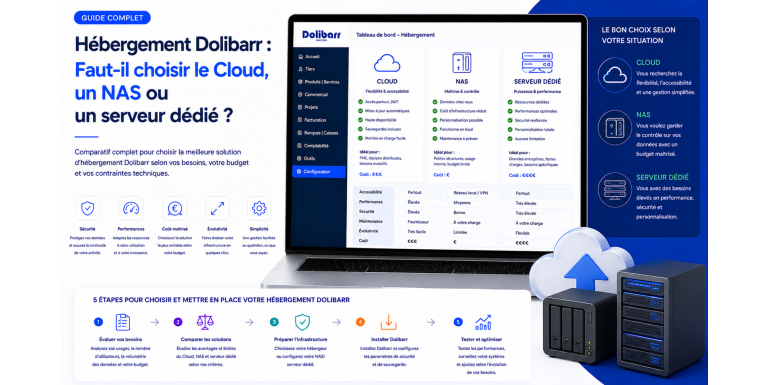
Once you have decided to adopt Dolibarr to manage your business, a practical question immediately arises: where to install it? On which type of infrastructure should the future IT core of your activity run? This decision is not trivial. It conditions the availability of your application, the security of your data, your annual budget, your capacity to evolve and even your level of autonomy in the face of breakdowns. Three main hosting families are available to you: the cloud in all its forms, the business NAS installed on your premises, and the dedicated server, either internal or hosted in a datacenter.
Each of these options has its advocates, its ideal use cases and its limits. The cloud appeals through its simplicity and absence of initial investment. The NAS reassures through the physical proximity of data and reduced marginal cost. The dedicated server offers power, mastery and scalability. None of these choices is universally better; the right answer depends on your size, your IT maturity, your budget, your compliance constraints and your strategy. In this guide, NEXT GESTION shares the analysis grid it applies with its clients to orient this structuring choice, honestly evaluating the strengths and weaknesses of each option.
Table of Contents
- Why the Hosting Choice Is Strategic
- The Criteria to Evaluate Before Any Choice
- The Cloud Option: SaaS and Virtual Servers Explained
- Strengths and Weaknesses of Cloud for Dolibarr
- The NAS Option: Installing Dolibarr at Home
- Strengths and Weaknesses of NAS for Dolibarr
- The Dedicated Server Option: Performance and Mastery
- Strengths and Weaknesses of Dedicated Server for Dolibarr
- The Backup Question in Each Scenario
- The Compared Security of the Three Solutions
- Expected Performance and Required Resources
- Real Compared Costs Over Five Years
- Legal Compliance and Data Sovereignty
- Typical Profiles: Which Choice for Which Business
- Migration Between Hosting Options
- The Role of the Integrator in Choice and Operation
- FAQ: Frequently Asked Questions About Dolibarr Hosting
1. Why the Hosting Choice Is Strategic
Dolibarr hosting is not a secondary technical subject that can be quickly handled after installation. It is on the contrary one of the structuring pillars of the project, at the same level as functional configuration and team training. A bad hosting choice can generate for years daily friction: recurring slowdowns, untimely unavailability, hazardous backups, drifting bills, uncertain compliance. Conversely, a well-thought-out hosting becomes invisible: it does its job silently and frees your energy for the business.
Four major dimensions are at stake. Availability concerns the fraction of time during which your application is usable by your teams. Over five working days, one hour of unavailability per week seems harmless but already represents five percent of your production time lost. Performance concerns response speed: opening an invoice in two seconds or fifteen seconds radically changes cumulative productivity. Security covers protection against data loss, intrusions and disasters. Mastery reflects your capacity to intervene, understand and evolve without depending exclusively on a third party.
The right hosting balances these four dimensions according to your profile. An SME of five people touching IT once a month will have very different needs from a mid-sized company with one hundred employees and a dedicated IT service. The consulting firm working at external clients has other priorities than the production workshop where everyone is on site. The analysis grid must therefore be personalized, and this is precisely what this guide proposes to build.
2. The Criteria to Evaluate Before Any Choice
Before comparing solutions, take the time to evaluate your situation according to an eight-criteria grid. This evaluation will transform a subjective choice into a rational decision.
First criterion, the number of concurrent users. Five concurrent users solicit infrastructure infinitely less than fifty. The needs curve is not linear but growing by tiers. This data determines minimum power and scaling strategy.
Second criterion, data volume. A Dolibarr weighing five hundred megabytes lives comfortably on any hardware. The same Dolibarr at fifty gigabytes, with numerous attachments and extended history, requires more solid infrastructure.
Third criterion, operational criticality. If Dolibarr stops, does your activity stop too? If the answer is yes within a few hours, availability must be maximum, which orients toward redundant architectures. If activity can continue a few days without Dolibarr, you have more flexibility.
Fourth criterion, geographical user dispersion. A team located in a single building favors internal solutions. A team dispersed across several sites, in telework or at clients, demands fluid and secure remote access.
Fifth criterion, internal IT maturity level. Do you have an IT service, a technical referent or no internal competence? This data strongly conditions solutions where you keep the hand and those where you delegate everything.
Sixth criterion, regulatory and compliance constraints. Health data, personal data subject to GDPR, sensitive trade secrets, sector certifications: these constraints may impose specific hosts, precise geographic locations or particular architectures.
Seventh criterion, available budget. Initial budget, recurring annual budget and sensitivity to variations must be quantified. Some solutions require significant initial investment and low recurring cost; others the opposite.
Eighth criterion, evolution strategy. Will your workforce double in three years? Will you open subsidiaries? Will you integrate other tools? Capacity to evolve without rethinking everything is a decisive criterion.
This eight-dimension grid, honestly filled, orients the rest of the reflection. It is a systematic prerequisite at NEXT GESTION during each hosting audit mission.
3. The Cloud Option: SaaS and Virtual Servers Explained
The cloud actually covers several very different realities that should be distinguished to avoid confusion.
Dolibarr SaaS, or Software as a Service, designates a Dolibarr instance installed and operated by a provider on its own infrastructure, accessible via browser from your workstation. You pay a monthly subscription per user. You take care of nothing technically: updates, backups, supervision are handled by the provider. This option is offered by several Dolibarr specialized players, including official partners.
VPS, or Virtual Private Server, designates a dedicated virtual server on which you install Dolibarr yourself. You rent a fraction of a physical machine at a host, with guaranteed resources: processor, memory, storage. You have full control over operating system, installation, configuration, backups. This option offers a compromise between flexibility and cost mastery.
Public cloud on major providers, type AWS, Azure or Google Cloud, allows hosting Dolibarr on highly scalable and richly equipped infrastructures. This route requires real technical expertise and a higher budget but offers unmatched elasticity. It suits especially companies with variable scale needs or high availability requirements.
Private cloud designates a cloud infrastructure dedicated to a single client, hosted at a provider or in a private datacenter. It combines the advantages of public cloud in elasticity with total data and resource isolation. This is an option for organizations with strong compliance or security constraints, generally from a certain size.
According to your profile and budget, one or another of these cloud forms may suit. NEXT GESTION itself offers a turnkey Dolibarr SaaS offering, as well as support for setup on VPS or public cloud.
4. Strengths and Weaknesses of Cloud for Dolibarr
The cloud presents structural advantages that explain its success with SMEs.
Setup simplicity is unbeatable. Subscribing to a SaaS offering takes minutes, and the application is immediately usable. No hardware to buy, no operating system to install, no network configuration to perform. You start in hours, not weeks.
The absence of initial investment frees up cash flow. You transform a capital expenditure into a recurring operating expense, gentler accounting-wise and more predictable budget-wise.
Delegated maintenance relieves you of technical tasks. Security updates, backups, supervision are handled by the provider. For a business without internal IT, this comfort radically changes daily life.
Remote access is native. Your employees in telework, at clients or traveling access Dolibarr from any browser connected to the Internet. No VPN to configure, no tunnel to maintain.
Scalability simplifies growth. Going from five to twenty users only requires a plan change. Doubling memory or storage of your VPS happens in a few clicks. Infrastructure adapts without disruption.
The cloud nevertheless presents limits to know.
Dependence on Internet connection is total. A cut from your access provider makes Dolibarr inaccessible. For poorly served areas or activities sensitive to interruptions, this is a vigilance point.
Financial recurrence ends up weighing. A SaaS at fifty euros per month per user for ten users represents six thousand euros per year, eighteen thousand euros over three years. Over the same duration, an internal server amortizes its initial investment.
Data mastery is partial. Your data lives on a third party's servers, in datacenters whose physical access you do not control. For certain sectors or certain corporate cultures, this dependence is a brake.
Customization may be limited depending on offerings. Some very standardized SaaS do not allow installation of third-party modules or modification of complex templates. Conversely, a VPS or public cloud leaves total freedom, provided you have the competence to take advantage.
The cloud particularly suits TPEs, fast-growing SMEs, multi-site structures and companies without internal IT competence. It suits less organizations with very high data sensitivity or very specific technical requirements.
5. The NAS Option: Installing Dolibarr at Home
The NAS, or Network Attached Storage, is originally a network storage device, generally sold by Synology, QNAP, Asustor or others. Modern NAS however integrate a complete operating system allowing the execution of applications, among which Dolibarr can run. This route appeals to SMEs wanting to keep their data internal while limiting complexity.
The principle is simple: you buy a NAS adapted to your size, install it on your premises, configure Dolibarr via a software package or via Docker, and access the application from your local network. Remote access for telework is done via a secure tunnel service offered by the manufacturer, such as QuickConnect at Synology.
This route presents a relatively accessible implementation. Modern NAS offer graphical assistants guiding installation. An SME with a resourceful IT referent can deploy Dolibarr on NAS in hours to days, without sharp expertise.
The total cost is attractive. An enterprise-grade NAS for five to twenty users costs between one thousand and three thousand euros to purchase, with a lifespan of five to seven years. No significant recurring subscription is necessary for the Dolibarr software itself, which remains free and open. Annual marginal cost is very low.
Data physically remains on your premises. For companies sensitive to sovereignty or confidentiality, this physical proximity is reassuring. You know where your data are, you have direct access to them, and no one else has access without your consent.
The NAS often serves other uses: shared file storage, workstation backup, hosting of complementary tools. Mutualizing this investment between several uses improves its profitability.
The NAS option particularly suits TPEs and SMEs between five and thirty users, with a main site, an activity not very critical over a few hours and a desire to master one's data. Beyond that, or for high availability constraints, limits show.
6. Strengths and Weaknesses of NAS for Dolibarr
The NAS combines several assets for a modest-size Dolibarr use.
Total cost of ownership is unbeatable. Mastered initial investment, no significant recurring subscription, lifespan of five to seven years amortize the equipment to an annual cost of a few hundred euros. For an SME, this is a very favorable economic equation.
Physical proximity of data reassures. You know where they are, have direct access to them, decide who accesses them. For companies with strong culture of confidentiality or sovereignty, this is an essential argument.
Autonomy from providers is total. You are not dependent on a SaaS editor that could disappear, change pricing or modify conditions. You master your technical destiny.
Mutualized NAS use for several functions amortizes the investment. File storage, workstation backup, Dolibarr hosting, complementary tool hosting: the same machine covers several needs.
Performance on a local network is generally excellent, provided the NAS is correctly sized. Latencies are quasi-null, transfers fast, and user experience very fluid for on-site teams.
Weaknesses must however be known.
Availability depends on your infrastructure. A power cut, hardware failure, incident on your router or network makes Dolibarr inaccessible. Without UPS, redundancy and emergency plan, you are exposed.
Remote access works but remains less fluid than on a real cloud. Manufacturer tunnel services have bandwidth limits and may slow down when your Internet connection is saturated.
Maintenance remains your responsibility. System security updates, Dolibarr updates, external backups, supervision are your responsibilities. Without internal technical referent or provider under contract, these tasks are quickly neglected.
Scalability is limited. Doubling your users or volume requires changing NAS or adding one, which constitutes a project itself. NAS do not scale as easily as cloud.
Physical security of your premises becomes critical. A fire, water damage or theft in your offices can take away your infrastructure. Without externalized backup, the risk is major.
The NAS is an excellent option for sedentary TPEs-SMEs, on a single site, with an activity tolerant to a few hours of unavailability and an available IT referent. NEXT GESTION regularly installs Dolibarr on Synology or QNAP for clients of this profile.
7. The Dedicated Server Option: Performance and Mastery
The dedicated server is a professional computer entirely dedicated to your Dolibarr, either hosted on your premises or in a datacenter. This is the historical route of SMEs and mid-sized companies wanting to totally master their infrastructure and obtain maximum performance.
Hosted on your premises, the internal dedicated server offers the mastery-proximity combination. You decide hardware, operating system, backups, redundancy. You precisely adapt power to your needs and keep your data at home. This is the typical route of structures with internal IT service or proximity provider under contract.
Hosted in a datacenter, the externalized dedicated server combines mastery and optimal operating conditions. The datacenter ensures redundant power supply, air conditioning, network connectivity, physical security. You rent the server and do what you want with it. This route separates software mastery from physical operation, balancing responsibilities.
The dedicated server offers power that far exceeds that of a NAS. For voluminous Dolibarr, intensive multi-user, or with complex integrations, the dedicated server remains the best option in raw performance.
Complete mastery allows all customizations. Third-party modules, specific developments, integrations with other software, fine optimizations, precise choice of complementary tools: nothing is forbidden. This freedom is precious for mature structures wanting a Dolibarr deeply aligned with their business.
Scalability is strong. Adding memory, storage, processors or even replacing the server are plannable operations. You adapt your infrastructure to your growth, without technical ceiling imposed by an editor.
This route however requires real competence or an engaged provider. Installation, maintenance, supervision, backups, security do not improvise. Without adapted internal or external resources, the dedicated server can become a burden.
8. Strengths and Weaknesses of Dedicated Server for Dolibarr
The dedicated server gathers several assets for mature organizations.
Raw performance is maximum. With adapted sizing, response times are at their lowest, heavy calculations execute quickly, massive imports do not slow user experience. This is the route offering best experiences on voluminous Dolibarr.
Total mastery opens all customization options. Modules, developments, integrations, fine optimizations: nothing is blocked. For mid-sized companies or strong sector-requirement structures, it is often the only way to precisely align the tool with the business.
Technical scalability is plannable. You decide to add resources, migrate to a new hardware generation, switch to redundant architecture according to your maturity and budget. No ceiling imposed by a SaaS editor.
Security, well conducted, reaches a high level. Dedicated firewall, data encryption, multi-site backups, permanent supervision, documented continuity plan: all professional levers are accessible.
Total cost over five to seven years can be very competitive. Initial investment is higher but recurring cost is low, and linear amortization gives an economic equation often better than SaaS over duration.
Weaknesses are also to consider.
Setup complexity is real. Hardware choice, system installation, Dolibarr configuration, securing, backups, supervision require time and competence. Start is longer than with SaaS.
Dependence on technical competence is strong. Without internal IT or provider engaged under maintenance contract, the dedicated server can become a risk rather than an asset. An unresolved breakdown paralyzes activity.
Initial investment is higher. For an SME of ten to thirty users, count between five thousand and fifteen thousand euros for a correct server, with a few thousand euros additional for securing and backups.
Redundancy, if necessary, weighs down the bill. A single server remains a single point of failure. To reach high availability, infrastructure must be doubled, which complicates and costs.
The dedicated server particularly suits SMEs from fifteen or twenty intensive users, mid-sized companies, structures with internal IT service or maintenance contract under provider, and organizations with strong requirements in customization, performance or compliance. NEXT GESTION regularly supports this type of deployment, from hardware choice to continuous supervision.
9. The Backup Question in Each Scenario
Whatever hosting solution chosen, backup remains the critical non-negotiable element. A Dolibarr instance without reliable backup is a risk no organization should take.
In the SaaS cloud scenario, backup is ensured by the provider. Verify however the precise conditions: frequency, retention duration, restoration modalities, possible fees on request. Ask your provider to perform a restoration test to validate the promise. Additional backup on your side, at regular intervals, is a good practice reducing dependence on the provider.
In the VPS or public cloud scenario, backup is generally your responsibility even if some hosts offer snapshot options. Set up automatic daily externalized backup, kept for at least thirty days, with monthly restoration test. The three-two-one rule, consisting of keeping three copies on two different supports including one off-site, is a solid reference.
In the NAS scenario, you must imperatively complete the main NAS with an externalized backup. A NAS is not a backup, it is active storage. A disaster on your premises, logical corruption or ransomware can destroy NAS and backup if everything is in the same place. Configure daily backup to an archive cloud, to a second remote NAS or to an external disk in rotation.
In the dedicated server scenario, set up a professional backup policy: daily incremental backups, weekly full backups, long-term retention, off-site externalization, regular restoration tests. Backup is the life insurance of your Dolibarr; it deserves necessary investment.
NEXT GESTION systematically includes a backup component in its Dolibarr maintenance contracts, with active supervision and regular tests, so its clients do not have to worry about this critical aspect.
10. The Compared Security of the Three Solutions
IT security covers several dimensions that should be compared for each solution.
For SaaS cloud, the provider handles the essential: security updates, communications encryption, suspicious access supervision, attack protection. Your responsibility concentrates on user account, password and authorization management. This division is comfortable for structures without security competence, provided choosing a serious and certified provider.
For self-managed VPS or public cloud, shared security attributes to you responsibility for the server itself: updates, firewall configuration, SSH access control, system hardening. A poorly configured VPS instance is quickly attacked. Either you have internal competence, or you delegate this responsibility to a provider under contract.
For NAS, security depends on your configuration. Manufacturers offer integrated functions: firewall, antivirus, intrusion detection, two-factor authentication. Still they must be activated and maintained. A poorly secured NAS exposed on the Internet is vulnerable. Ransomware particularly targets weakly protected SME NAS.
For dedicated server, security is entirely in your hands or those of your provider. Reachable level is maximum, provided investing: firewall, supervision, logging, encryption, hardening, regular audits. Without this investment, the dedicated server can paradoxically be less secure than a well-kept SaaS.
The human factor remains central in all configurations. Robust passwords, two-factor authentication, team sensitization to phishing, rigorous user rights management are universal practices no technical solution can replace.
NEXT GESTION systematically recommends evaluating the real security level after a few months of use, by a targeted audit identifying gaps from best practices. This regular review protects against silent erosion of security.
11. Expected Performance and Required Resources
Performance perceived by users depends on several factors: server power, network quality, software configuration, database volume. Here are typical orders of magnitude for Dolibarr.
For five concurrent users and a database below five gigabytes, count two to four processor cores, four to eight gigabytes of memory, one hundred to two hundred gigabytes of SSD storage. This configuration runs comfortably on a mid-range NAS, a small VPS or an entry-level server.
For ten to twenty concurrent users and a database of five to twenty gigabytes, count four to eight cores, eight to sixteen gigabytes of memory, two hundred to five hundred gigabytes of SSD storage. This configuration requires a high-end NAS, a substantial VPS or an entry-level dedicated server.
For thirty to fifty concurrent users and a database of twenty to fifty gigabytes, count eight to sixteen cores, sixteen to thirty-two gigabytes of memory, five hundred gigabytes to one terabyte of SSD storage. At this stage, the NAS reaches its limits and the dedicated server becomes the natural route.
Beyond fifty intensive users, or for heavily customized Dolibarr with multiple modules, analysis becomes finer and requires individualized audit. Multiple servers in load balancing, dedicated databases, Redis caches, specific optimizations come into play.
Performance also depends on storage. SSD is now the standard; mechanical disks only suit archives. NVMe brings additional gain on intensive loads. A Dolibarr installed on SSD responds in a few milliseconds where a mechanical disk would take several seconds.
The network finally influences experience. On a gigabit local network, latency is negligible. On a variable quality Internet connection, friction may appear. Good practice consists of measuring real latency and bandwidth between your user workstations and your Dolibarr, and adjusting sizing accordingly.
12. Real Compared Costs Over Five Years
Honestly comparing costs requires reasoning over five years and integrating all components: initial investment, subscriptions, maintenance, backups, mobilized human resources.
For a Dolibarr SaaS scenario of ten users at fifty euros per month per user, annual cost is six thousand euros, thirty thousand euros over five years, without initial investment. Add a few hundred euros annually for complementary backups and possible customizations.
For a NAS scenario of ten users with an enterprise Synology NAS at two thousand five hundred euros, plus an externalized backup at three hundred euros per year, plus a maintenance contract at one thousand euros per year, total cost over five years is around nine thousand euros. To this add a few internal hours of management, three hundred hours over five years, valued at fifteen thousand euros if you count the full cost of your IT referent.
For an internal dedicated server scenario of ten users with a server at eight thousand euros, a UPS, externalized backups and a maintenance contract at two thousand euros per year, total cost over five years is around eighteen thousand euros, plus internal hours cost.
For a mid-range public cloud VPS scenario at one hundred fifty euros per month, plus two thousand euros of annual administration services, total cost over five years is nineteen thousand euros.
These orders of magnitude show that SaaS remains competitive for small undemanding teams, that NAS is financially unbeatable for sedentary SMEs if internal time value is not quantified, and that dedicated server or VPS are economically justified from a certain size or strong technical requirements.
Real total cost also includes unavailability. One day of stop for fifty users represents production loss equivalent to several thousand euros. This dimension, difficult to quantify but real, must enter the trade-off.
13. Legal Compliance and Data Sovereignty
According to your sector and geography, certain legal constraints strongly orient hosting choice.
For personal data subject to European GDPR, hosting in the European Union is strongly recommended. Several Dolibarr SaaS providers and several VPS hosts explicitly offer European, even French datacenters. Verify effective localization and contractual commitments.
For health data in France, HDS certification, Health Data Hosting, is mandatory. Only a few hosts are certified; choice is considerably restricted. If your activity touches health, ask the question from the start.
For administrations and public bodies, specific rules may impose sovereign or qualified hosts, like SecNumCloud in France. This constraint orients toward very specific solutions.
For financial, accounting and fiscal data, legal retention duration imposes a long-term archiving strategy, independent of operational hosting solution. Whatever solution chosen, an archiving plan must be documented.
For sensitive industrial or commercial secrets, hosting at a certified third party can raise reservations. The internal dedicated server or NAS on your premises bring additional serenity, provided being correctly secured.
NEXT GESTION systematically advises its clients on these legal aspects and supports the choice of hosting aligned with sector constraints. A bad compliance decision can cost dearly: GDPR sanctions, contract losses, reputation damage.
14. Typical Profiles: Which Choice for Which Business
To facilitate trade-off, here are five typical profiles and the orientation NEXT GESTION generally recommends.
Profile one, the TPE of less than five people, single-site, without internal IT, without particular sector constraint. Orientation: turnkey Dolibarr SaaS, or entry-level NAS with externalized maintenance contract. Simplicity prevails over mastery, and budget remains contained.
Profile two, the SME of ten to thirty people, single-site or bi-site, with IT referent available a few days per month, activity not critical over a few hours. Orientation: enterprise NAS under Synology or QNAP, with externalized backup and targeted maintenance contract. Economic equation is optimal and mastery remains strong.
Profile three, the SME of twenty to fifty people, multi-site, growing, with need for fluid telework and first customization requirements. Orientation: managed VPS or private cloud at a Dolibarr specialized partner. Remote access is native, scalability guaranteed, and partner expertise covers technical needs.
Profile four, the mid-sized company of fifty to two hundred people, with internal IT service, strong customization requirements, multiple integrations, compliance constraints. Orientation: dedicated server either internal or in datacenter, with redundant architecture and documented continuity plan. Mastery and performance prevail.
Profile five, the group with several entities, multi-geographic, strong sector regulatory requirements. Orientation: dedicated private cloud, infrastructure managed by specialized provider, with custom-designed architecture. This route requires superior investment but aligns with stakes.
These profiles are landmarks; each situation deserves fine analysis. NEXT GESTION conducts this audit as part of its Dolibarr hosting consulting missions.
15. Migration Between Hosting Options
Good news: initial choice is not frozen. Migrating from one hosting to another is technically feasible and rather well equipped on Dolibarr.
Migrating from SaaS to internal server or VPS requires exporting database and files from SaaS, followed by restoration on new infrastructure. This operation generally takes hours to days depending on volume and complexity. Verify before subscription that your SaaS provider accepts this restitution in case of departure.
Migrating from NAS to dedicated server follows the same principle: complete backup of existing Dolibarr, restoration on new server, access switching. The main difficulty is planning the switch to minimize unavailability.
Migrating from dedicated server to cloud can be considered to reduce operational load, provided accepting the change of financial model and lesser mastery.
Whatever the direction, anticipate migration from initial choice by favoring open and exportable solutions. A SaaS that does not allow complete export of your database is a trap from which you cannot escape painlessly.
NEXT GESTION regularly supports inter-hosting migrations, sometimes for cost reasons, sometimes for performance reasons, sometimes for strategic reasons. This flexibility is part of the advantages of the open Dolibarr ecosystem.
16. The Role of the Integrator in Choice and Operation
Whatever the hosting chosen, a specialized Dolibarr integrator brings significant value at several stages.
Upstream of choice, the integrator audits your needs, sizes the solution, compares quantified options, advises on trade-offs. This consulting mission avoids costly errors and orients toward the most relevant solution.
At deployment, the integrator installs Dolibarr, configures modules, secures access, sets up backups, trains administrators. This technical phase conditions the quality of daily operation.
In continuous operation, the integrator ensures application maintenance, version upgrades, user support, backup supervision, configuration evolution. This support relieves your teams of technical subjects and guarantees availability.
In case of evolution need, the integrator advises on hosting changes, module additions, integrations with other tools. This continuity of support transforms Dolibarr into a lasting efficiency lever.
NEXT GESTION covers this entire chain: upstream consulting, deployment, training, maintenance and strategic support. According to your hosting choice, our services adapt to bring you necessary expertise without overloading your organization.
17. FAQ: Frequently Asked Questions About Dolibarr Hosting
What is the cheapest solution to host Dolibarr? Short term, entry-level SaaS for a small team. Long term and for larger teams, internal NAS remains financially unbeatable, provided accepting to devote some internal time. The equation strongly depends on your size and maturity.
Is Dolibarr SaaS as performant as a dedicated server? For standard uses and modest-size databases, yes. Beyond certain volumes or for intensive loads, dedicated server remains more performant because its resources are shared with no one.
Are my data really secure in the cloud? With a serious and certified provider, yes. The security level of professional SaaS often exceeds that of poorly secured NAS at an SME. Verify certifications, datacenter localization and contractual guarantees before subscription.
Can I host Dolibarr on a Synology NAS? Yes, Dolibarr works very well on recent Synology NAS, via Docker or via a community package. For moderate volumes, it is an excellent economic option. NEXT GESTION regularly deploys this configuration at SME clients.
What is the cost of Dolibarr hosting in a datacenter? Count between one hundred and three hundred euros per month for an SME-range managed VPS, and between two hundred and five hundred euros per month for a datacenter dedicated server, excluding administration services. Ranges vary by provider and options.
Should I back up Dolibarr even on SaaS? Ideally yes, to have a copy of your data independent of the provider. Most serious SaaS accept regular database export, to be kept in a third-party backup space.
How many users can Dolibarr support? No absolute software limit. With adapted sizing, Dolibarr runs without difficulty several hundred concurrent users. Beyond, advanced architectures come into play to preserve performance.
How to choose between a managed VPS and a non-managed VPS? A managed VPS includes system administration and technical support; you pay more but gain tranquility. A non-managed VPS is cheaper but requires technical competence for operation. For an SME without IT, managed is generally preferable.
Article written by NEXT GESTION, Dolibarr expert and partner of companies in choosing and operating their ERP/CRM infrastructure. Hesitating about the Dolibarr hosting solution suited to your business? Contact our consultants: contact@nextgestion.com.