
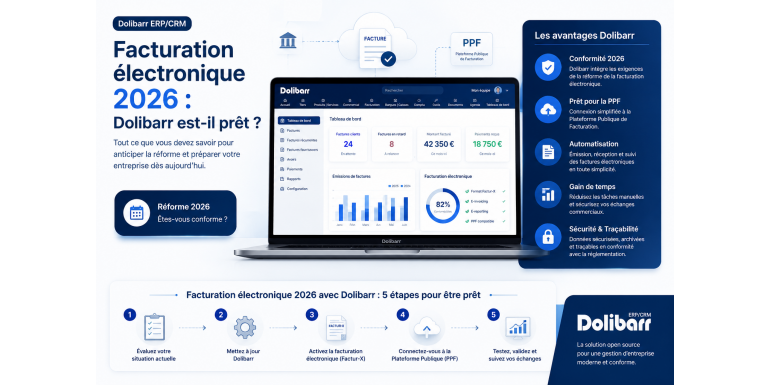
Mandatory electronic invoicing became one of the biggest regulatory challenges French companies have faced in recent years in 2026. Initially planned for 2024, and repeatedly postponed for technical and organizational reasons, this reform is finally being phased in between 2026 and 2027, requiring all VAT-registered businesses to issue and receive their B2B invoices in a structured electronic format, via a state-approved platform.
In this context, a crucial question arises for the tens of thousands of French companies using Dolibarr as their ERP system: is this open-source software ready to support its users in their transition to electronic invoicing? What modules, connectors, and functionalities are available to comply with legal requirements? How can they prepare effectively, and at what cost? This article provides detailed and practical answers to all these questions.
Understanding the 2026 electronic invoicing reform
Electronic invoicing, in its French legal and regulatory sense, is not simply a matter of sending an invoice in PDF format by email. An electronic invoice, as defined by law, is an invoice issued, transmitted, and received in a structured, electronic format, containing data that can be automatically processed by computer systems (in XML format), and necessarily transmitted via an approved third-party platform.
This reform pursues several major objectives for the French government and economy: combating VAT fraud (estimated at over €15 billion per year), simplifying companies' reporting obligations, accelerating payment times, and improving economic management through real-time tax data. For businesses, it also presents an opportunity to modernize their processes, reduce processing costs (estimated at €4-10 per paper invoice compared to less than €1 for electronic invoices), and eliminate payment delays due to losses or administrative errors.
All VAT-registered businesses established in France are subject to this obligation, regardless of their legal status (SARL, SAS, EURL, micro-enterprise) or size. This represents approximately 4 million French businesses that must adapt their processes and IT systems.
The official timetable for the reform
The implementation schedule is gradual, staggered according to company size to allow for an organized transition. As of the date of writing this article in 2026, the schedule established by the French government is as follows:
• From September 1, 2026: mandatory receipt of electronic invoices for ALL companies subject to VAT, without exception.
• From September 1, 2026: obligation to issue electronic invoices for large companies (GE) and medium-sized companies (ETI).
• From September 1, 2027: obligation to issue for SMEs and micro-enterprises.
This phased approach means that by 2026, even if you are a very small business, you must be able to receive electronic invoices issued by your large or medium-sized business suppliers. This often underestimated point makes preparation urgent now, even if your own obligation to issue electronic invoices doesn't come into effect until 2027.
The key players in electronic invoicing: PPF, PDP, OD
The French reform relies on an ecosystem of mandatory intermediary platforms. Understanding their role is essential for choosing the right solution and correctly configuring your ERP system, such as Dolibarr.
The Public Billing Portal (PPF)
The PPF is the free government platform managed by the DGFiP (French Public Finances Directorate). Initially intended as a universal platform, its role was reduced following the 2023 announcements: it now primarily serves as a tax data aggregator and central business directory. Businesses can use it as an issuance/receipt platform for simple cases, but most will use private PDPs (Public Data Platforms).
Partner Digitalization Platforms (PDPs)
PDPs are state-approved private platforms that ensure the secure transmission of electronic invoices between senders and recipients. More than 80 PDPs were registered in 2025-2026, including major players such as Generix, Tenor, Esker, Doc Process, Yooz, Pennylane, Sage, and Quadient. Choosing your PDP is a strategic decision: it will determine your costs, features, and the efficiency of your transactions.
Digitalization Operators (DOs)
Data Processing Organizations (DPs) are non-accredited service providers (but linked to a Data Processing Platform) that can enhance the offering with additional features: format conversion, legal archiving, data validation, and integration with your accounting system. They operate upstream or downstream of the Data Processing Platform.
Mandatory electronic formats: Factur-X, UBL, CII
The French reform mandates three accepted structured electronic formats, conforming to the European standard EN 16931. Understanding these formats is essential to assess whether Dolibarr can generate compliant invoices.
Factur-X (PDF/A-3 hybrid)
Factur-X is the most popular format in France because it combines the best of both worlds: a visually readable PDF for humans and an embedded structured XML file for automated processing. It's a hybrid format that facilitates adoption because users still see a traditional invoice. Dolibarr natively supports the generation of Factur-X invoices through several dedicated modules.
UBL (Universal Business Language)
UBL is an international XML standard widely used in Northern Europe and government agencies. It is purely structured, without a native PDF representation. Dolibarr can generate UBL invoices via add-on modules.
CII (Cross Industry Invoice)
CII is another standardized XML format, used notably by French and Belgian government agencies via Chorus Pro. Dolibarr also supports this format through dedicated modules.
Is Dolibarr ready for electronic invoicing by 2026?
This is the central question that legitimately concerns Dolibarr users in 2026. The answer is nuanced but overall positive: yes, Dolibarr is technically ready to support its users towards electronic invoicing, provided they activate the right modules and choose the right PDP connector.
Since version 18 and even more so with versions 19, 20 and following released in 2025-2026, Dolibarr natively integrates several key features related to electronic invoicing: generation of invoices in Factur-X format, support for the EN 16931 standard, management of mandatory information in accordance with the reform, legal archiving, precise identification of third parties via their SIREN/SIRET.
The French Dolibarr community has been particularly active on this topic, with several developers and service providers working in collaboration with major PDPs to ensure interoperability. Official and third-party modules now allow for the end-to-end sending, receiving, and management of electronic invoice flows.
Dolibarr modules dedicated to electronic invoicing
The native Factur-X module
Dolibarr offers a standard feature: the ability to generate invoices in Factur-X format. Once activated, each invoice issued from Dolibarr can be automatically generated as a PDF/A-3 with embedded XML compliant with the EN 16931 standard. This module is free and is part of the core Dolibarr functionality.
PDP connector modules
Several third-party modules, available on the official DoliStore or from specialized providers, allow you to directly connect Dolibarr to approved PDPs (Payment Processing Platforms). These modules automate the sending of invoices to your PDP, which then handles their delivery to the recipient via the French ecosystem. For example, connectors exist for Generix, Tenor, Doc Process, Pennylane PDP, and several other providers.
The reception and integration modules
For receiving supplier invoices, specific modules allow Dolibarr to automatically retrieve incoming electronic invoices from your PDP, integrate them as supplier invoices in the ERP, and pre-fill the accounting fields through automatic extraction of XML data.
How to prepare your Dolibarr for electronic invoicing?
Here is a concrete roadmap to bring Dolibarr into compliance with mandatory electronic invoicing for 2026-2027:
Step 1: Update Dolibarr
If you are using an older version of Dolibarr (prior to version 18), you must upgrade to the latest stable LTS version. Electronic invoicing features are constantly evolving, and only a recent version guarantees access to the latest improvements and fixes.
Step 2: Verify the quality of your third-party repository
Electronic invoicing requires accurate and reliable identification of each third party. Verify that all your customers and suppliers are correctly registered with their SIREN, SIRET, intra-community VAT number, full postal address, and country code. Incomplete or incorrect information is one of the main sources of error when sending electronic invoices.
Step 3: Choose and contract with a PDP
Compare PDP offers based on your needs: volume of invoices issued and received, native integrations with Dolibarr, pricing, support quality, and additional services (archiving, electronic signature, e-reporting). Sign a contract with your chosen PDP at least 3 months before your obligation expires.
Step 4: Install and configure the PDP connector
Install the connector module corresponding to your PDP in Dolibarr, configure the connection settings (API URL, credentials, certificates if required), and test sending a few test invoices. This testing phase is crucial to verify that the flow functions correctly from end to end.
Step 5: Train your teams
Your employees need to understand the new rules: the status of electronic invoices (submitted, accepted, rejected, paid), how recipients handle rejections, tracking acknowledgments of receipt, managing credit notes, and making corrections. Half a day of training is usually sufficient for a team of 2 to 5 people.
What costs should be expected?
Bringing Dolibarr into compliance with electronic invoicing represents a modest investment compared to other solutions on the market. Here are the typical costs to anticipate for a very small business:
• Dolibarr update: free if you manage the operation internally, between €200 and €800 via a service provider.
• PDP connector module: usually between €100 and €500 as a one-off purchase on the DoliStore, sometimes included by the PDP.
• PDP subscription: between €0 and €50/month depending on the volume of invoices and the PDP chosen (some offers include a free volume of invoices per month for small businesses).
• Cost per invoice transmitted: generally between €0.10 and €0.80 depending on the PDP and volume.
• Training and support: between €300 and €1,500 for a complete commissioning with a specialist provider.
Generally, for a very small business issuing 50 invoices per month, budget between €500 and €2,500 for the first year, then between €200 and €800 per year on a recurring basis. These amounts remain far less than the hidden costs of non-compliance (rejected invoices, late payments, tax penalties).
Mistakes to avoid in your compliance efforts
Several classic pitfalls await unprepared companies. Avoid them by paying attention to the following points:
First, don't wait until the last minute. Many companies think they have until the very last day of the deadline to get equipped. This is a strategic mistake: Dolibarr PDPs and service providers will be fully booked as the deadline approaches, and you risk not finding an integration slot. Prepare your transition at least 6 months before your issuance deadline.
Secondly, neglecting the testing phase. Too many companies switch to production without properly testing their workflows. The first few days in real-world conditions are then a nightmare: rejected invoices, missing data, formatting errors. Dedicate at least 2 to 4 weeks to realistic testing before the final switchover.
Third, choose a PDP without native Dolibarr integration. Some PDPs are excellent players but don't (yet) have a Dolibarr connector. You will then have to develop or have this integration developed, with unforeseen costs and delays. Prioritize PDPs that already have a functional and proven Dolibarr module.
Fourth, underestimating the human element. Electronic invoicing changes habits: no more PDFs sent by email, tracking of acknowledgments, management of rejected invoices. Without proper training and change management support, your team can find themselves lost despite a technically perfect tool.
Beyond 2026: Electronic invoicing as an opportunity
Electronic invoicing isn't just a requirement to be met; it's also a fantastic opportunity to modernize your internal processes. Dolibarr, thanks to its modularity and open philosophy, allows you to go far beyond simple compliance.
Take advantage of this transition to fully automate your invoicing cycle: automatic generation from delivery notes, automatic sending to customers, automatic payment tracking via bank reconciliation, and automatic accounting. These automations, accessible with Dolibarr, can save you several hours per week, equivalent to thousands of euros per year for a very small business.
Take advantage of the arrival of structured data to manage your business in real time: dashboards, performance indicators, and margin analyses per customer. The wealth of data generated by electronic invoicing is a strategic asset for managers who want to run their business with precision.
Finally, electronic invoicing is also a commercial argument: being compliant now, when many companies are lagging behind, can become a differentiating factor when signing new contracts, particularly with large companies and administrations.
Conclusion: Dolibarr, a trusted partner for electronic invoicing
To answer the question posed in the title: yes, Dolibarr is ready for e-invoicing in 2026-2027. The software integrates the required technical standards (Factur-X, UBL, CII), has connector modules with the main PDPs on the market, and benefits from a very active French community on this topic. Dolibarr users can approach this transition with confidence, provided they prepare methodically and well in advance.
Compared to many proprietary software solutions that charge for e-invoicing compliance as a premium module, sometimes several hundred euros per year, Dolibarr offers a major economic advantage: the majority of features are free or available at a moderate cost on the DoliStore. This accessibility is a valuable asset for very small businesses and SMEs that need to control their IT budget.
If you already use Dolibarr, your main task is to update your installation to the latest stable version, choose a compatible PDP, and install the corresponding connector. If you are not yet using Dolibarr and are faced with this requirement, this might be the perfect opportunity to adopt a modern, free, and compliant ERP solution right from the start.
In any case, don't wait until the last few weeks before your deadline to prepare. Electronic invoicing by 2026 is a major operational challenge, but also an opportunity for modernization. With Dolibarr and tailored support, your company can transform this regulatory requirement into a lasting competitive advantage.
Take stock of your situation today, identify your precise deadline, choose your PDP (Project Data Platform) and support provider, and calmly prepare for your transition to e-invoicing. Your customers, suppliers, and tax authorities will thank you, and you'll gain operational efficiency for years to come.
The French Dolibarr community is actively engaged on this topic through free webinars, detailed tutorials, dedicated forums, and specialized Facebook groups. Don't hesitate to take advantage of these free resources before investing in paid services: you'll often find answers to your questions, feedback from other users, and very practical configuration tips. This collective intelligence is one of the differentiating strengths of the French-speaking open-source ecosystem compared to proprietary, locked-down solutions.
To learn more, regularly check the official announcements from the French Public Finances Directorate (DGFiP) on impots.gouv.fr, the dolibarr.org website for new versions and modules, and communications from your PDP (Payment Data Platform). Regulations may change, formats may be enhanced, and new features may appear. Stay informed to maintain a competitive edge and make electronic invoicing a true strategic asset for your business rather than a mere administrative burden.