
1. Introduction
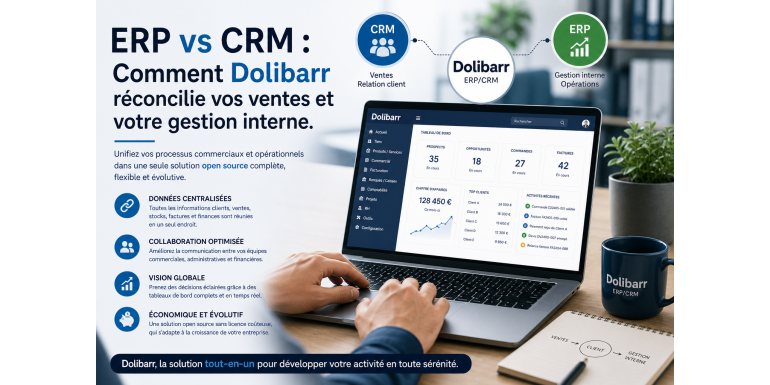
In an increasingly competitive and digital business environment, companies must rely on powerful tools to manage their operations effectively. Two major categories of software dominate modern business management: ERP (Enterprise Resource Planning) and CRM (Customer Relationship Management). These systems have long been used separately, often creating data silos and operational inefficiencies. However, the convergence of ERP and CRM has now become a strategic priority for organizations seeking to improve overall performance. In this context, Dolibarr ERP CRM stands out as an innovative solution capable of reconciling these two worlds within a single, unified system. This article provides an in-depth exploration of the differences between ERP and CRM, their limitations when used independently, and how Dolibarr enables companies to unify sales management with internal operations in 2026.
2. Understanding the Difference Between ERP and CRM
An ERP system is designed to manage all internal processes within a company. It centralizes data and automates operations related to accounting, purchasing, inventory, production, and human resources. The primary objective of an ERP is to optimize internal workflows and ensure better coordination across departments.
A CRM system, on the other hand, focuses on managing customer relationships. It helps track leads, manage sales opportunities, improve customer communication, and enhance the performance of sales teams. The main goal of a CRM is to increase sales and improve customer satisfaction.
Historically, these systems were developed separately, each addressing specific business needs. However, this separation often leads to data inconsistencies and lack of coordination between teams.
3. The Limitations of Separate ERP and CRM Systems
Using separate systems for internal management and customer relationships presents several drawbacks. First, it leads to data duplication. Customer information must be entered into the CRM and then transferred to the ERP, increasing the risk of errors and inconsistencies.
Second, communication between departments is often limited. Sales teams and administrative or financial teams work on different systems, which can result in delays and misunderstandings.
Additionally, the lack of a unified view makes decision-making more complex. Business leaders must consult multiple systems to get a complete picture of operations, reducing responsiveness and strategic efficiency.
Finally, the costs associated with integrating multiple solutions can be high, including licensing, maintenance, and training expenses.
4. The Shift Toward Integrated Solutions
To overcome these limitations, companies are increasingly adopting integrated solutions that combine ERP and CRM functionalities within a single platform. This approach allows for data centralization, improved communication between departments, and reduced operational costs.
Integrated solutions also provide a better user experience, as teams can access all relevant information from a single interface. This trend reflects the growing need for simplification and process optimization in a rapidly changing business environment.
5. Dolibarr: A Solution for ERP and CRM Convergence
Dolibarr stands out for its native integration of ERP and CRM features. Unlike other solutions that require additional modules or complex integrations, Dolibarr offers a unified platform from the outset.
This integration allows businesses to manage the entire customer lifecycle, from lead generation to invoicing and payment tracking. All data is centralized, ensuring consistency and reliability.
Moreover, Dolibarr provides a single interface that enables different departments to collaborate efficiently. Sales, administrative, and financial teams can access the same information in real time, improving coordination and productivity.
6. Unified Customer Lifecycle Management
One of Dolibarr’s key advantages is its ability to manage the entire customer lifecycle within one system. From the moment a prospect is created, their information is stored in the CRM. Once the prospect becomes a customer, the data seamlessly flows into ERP modules for order management, invoicing, and payments.
This continuity eliminates data loss and ensures a smooth customer experience. Sales teams can track deal progression, while administrative teams handle financial aspects without disruption.
7. Improved Collaboration Across Departments
Dolibarr enhances collaboration across departments by centralizing data. Information is accessible to all relevant stakeholders, improving communication and operational efficiency.
For example, sales teams can review a customer’s payment status before proposing new deals, while accounting teams can access sales data to better understand transactions.
This level of collaboration improves responsiveness and supports better-informed decision-making.
8. A Comprehensive View of Business Operations
With Dolibarr, business leaders gain a complete view of company activities. Dashboards provide real-time insights into sales performance, financial health, and operational efficiency.
This global visibility enables faster and more accurate decision-making, helping organizations identify opportunities and mitigate risks.
9. Reduced Costs and Complexity
Combining ERP and CRM functionalities in a single solution significantly reduces costs associated with managing multiple systems. Businesses no longer need to handle multiple licenses or complex integrations.
Training is also simplified, as users only need to learn one system. This simplification improves overall efficiency and reduces operational overhead.
10. A Solution Tailored for SMEs
Dolibarr is particularly well-suited for small and medium-sized enterprises, which often have limited resources. Its ease of use and modular design allow companies to implement a complete management system without significant investment.
SMEs can benefit from both ERP and CRM capabilities without the complexity and cost of traditional enterprise solutions.
11. A Scalable Platform
Dolibarr is designed to grow alongside the business. Modules can be activated or added based on evolving needs, ensuring the system remains aligned with business growth.
This scalability is essential for companies seeking long-term adaptability and sustainability.
12. Impact on Sales Performance
The integration of CRM features within Dolibarr enhances sales performance. Teams have access to tools that help track leads, analyze opportunities, and optimize sales strategies.
Centralized data also enables better customer insights, allowing companies to tailor offers and improve conversion rates.
13. Impact on Internal Management
On the ERP side, Dolibarr streamlines internal processes. Inventory management, order processing, and accounting are automated, reducing errors and improving efficiency.
This optimization allows businesses to focus on their core activities and increase productivity.
14. Outlook for 2026
By 2026, the convergence of ERP and CRM will become the standard. Businesses will increasingly seek integrated solutions capable of addressing all operational needs.
Dolibarr aligns perfectly with this trend by offering a unified, flexible, and scalable platform.
15. Conclusion
The traditional separation between ERP and CRM is gradually disappearing in favor of integrated solutions that address modern business challenges. Dolibarr embodies this transformation by reconciling sales management with internal operations within a single system.
Thanks to its modularity, simplicity, and cost efficiency, it represents an ideal solution for businesses looking to improve overall performance. In 2026, choosing Dolibarr means embracing unified, efficient, and future-ready business management.