
1. Introduction
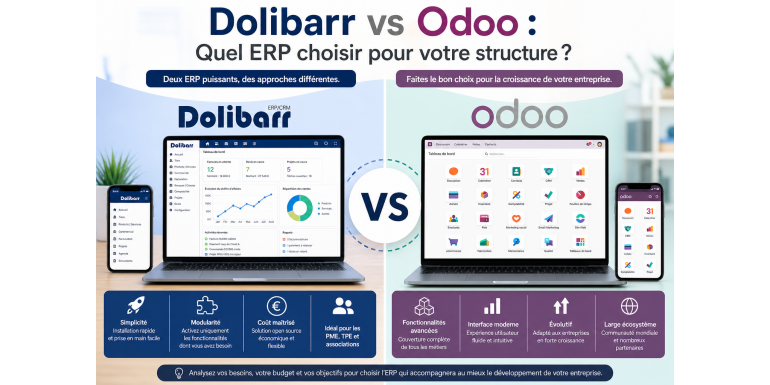
Choosing an ERP is a major strategic decision for any company looking to structure its management, improve productivity, and support growth. Among the many solutions available on the market, two names frequently stand out in discussions among business leaders and IT managers: Dolibarr ERP CRM and Odoo. Both open-source solutions offer rich functionalities covering sales management, accounting, human resources, logistics, and much more. However, they differ significantly in their approach, complexity, cost, and target audience. In this article, we will analyze in detail the differences between Dolibarr and Odoo to help you choose the ERP that best fits your organization.
2. Overview of Dolibarr
Dolibarr is an open-source ERP and CRM primarily designed for small and medium-sized businesses, freelancers, and associations. It stands out for its ease of installation, simplicity of use, and modular design. The interface is intuitive, allowing users to quickly get started even without advanced technical skills. Dolibarr offers a wide range of modules covering essential needs such as customer management, invoicing, product management, inventory, and project tracking. Its modular architecture allows users to activate only the features they need, making it lightweight and efficient.
3. Overview of Odoo
Odoo is a more comprehensive and complex open-source ERP solution aimed at businesses of all sizes, including large organizations. It offers a broad suite of applications covering nearly every aspect of business management: CRM, sales, accounting, human resources, marketing, e-commerce, manufacturing, and more. Odoo stands out for its modern interface and advanced features, but this richness comes with increased complexity and often higher costs, especially in its enterprise version.
4. Philosophy and Positioning of Both ERPs
Dolibarr follows a simple and pragmatic approach, aiming to provide an accessible and efficient tool for organizations seeking a quick-to-deploy and easy-to-maintain solution. In contrast, Odoo takes a more ambitious approach, aiming to cover all business needs within a single integrated platform. This difference in philosophy directly impacts the choice of companies depending on their size, budget, and requirements.
5. Ease of Installation and Adoption
One of Dolibarr’s key strengths is its ease of installation. It can be deployed within minutes on a server or used as a SaaS solution. Configuration is quick, and the interface is intuitive, allowing users to get started rapidly. Odoo, on the other hand, requires a more complex installation, especially in its community version. Its adoption also takes more time due to its extensive features and structured environment. For SMEs without a dedicated technical team, Dolibarr is generally more accessible.
6. User Interface and Experience
Dolibarr offers a simple and functional interface focused on efficiency. Although it is less modern than Odoo’s, it remains clear and easy to navigate. Odoo, by contrast, provides a more modern, ergonomic, and visually appealing interface. The user experience is smoother, thanks to optimized navigation and design. However, this richness can sometimes make the interface more complex for beginners.
7. Features and Business Coverage
Odoo has an advantage in terms of feature richness. It offers applications for virtually all business needs, including advanced areas such as manufacturing management, marketing automation, and e-commerce. Dolibarr covers essential business needs but may require additional modules for specific functionalities. However, for SMEs, Dolibarr’s features are often more than sufficient.
8. Modularity and Customization
Both solutions are modular, but their approaches differ. Dolibarr allows users to easily enable or disable modules according to their needs, with simple configuration. Odoo also offers strong modularity, but customization often requires advanced technical skills. Custom development in Odoo can be more expensive and complex than in Dolibarr.
9. Cost and Business Model
Dolibarr is fully open source and free in its base version. Costs mainly relate to hosting, maintenance, and possibly purchasing additional modules. Odoo offers a free community version, but many advanced features are only available in the paid enterprise version. Costs can increase quickly depending on the number of users and modules used.
10. Maintenance and Scalability
Dolibarr is relatively easy to maintain and update. Its lightweight architecture makes technical management more accessible. Odoo, on the other hand, often requires technical expertise for maintenance, especially when customizations are involved. However, Odoo offers better scalability for fast-growing businesses thanks to its advanced capabilities.
11. Performance and Infrastructure
Dolibarr is lightweight and can run on modest infrastructure, making it ideal for small businesses. Odoo, due to its complexity, generally requires more powerful infrastructure, especially for installations with many users or modules.
12. Community and Ecosystem
Odoo benefits from a large global community and a rich ecosystem of partners and developers. Dolibarr also has an active community, though smaller. However, Dolibarr offers a solid ecosystem of modules, particularly through platforms such as Dolistore and other specialized marketplaces.
13. Use Cases: Which Solution for Which Business
Dolibarr is particularly well-suited for small businesses, startups, and associations looking for a simple, fast, and cost-effective solution. Odoo is better suited for companies with complex needs, rapid growth, or specific business requirements requiring a more advanced system.
14. Advantages and Disadvantages
Dolibarr stands out for its simplicity, low cost, and quick implementation but may be limited for highly advanced needs. Odoo offers extensive functionality and a modern interface but can be more complex and costly for some organizations.
15. Conclusion
The choice between Dolibarr and Odoo depends primarily on your needs, budget, and level of digital maturity. If you are looking for a simple, quick-to-deploy, and cost-effective solution, Dolibarr is an excellent choice. If you have complex requirements and a larger budget, Odoo may be more suitable. In any case, it is essential to carefully analyze your business processes and objectives before making a decision to ensure you select the ERP that best supports your company’s growth.