Introduction
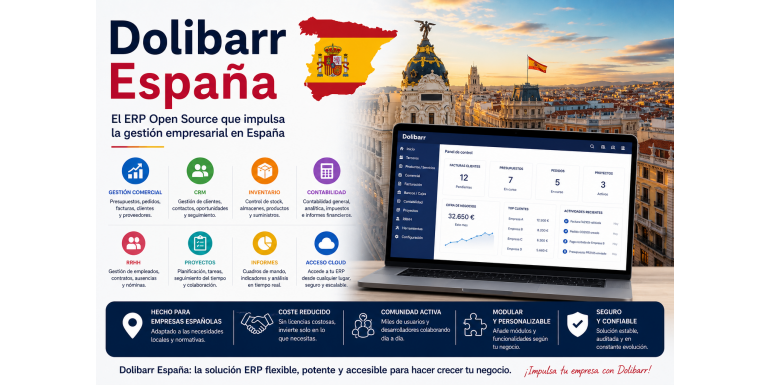
Spain holds a strategic position within the European open-source software ecosystem, particularly in the field of ERP systems designed for small and medium-sized businesses. In this context, Dolibarr ERP CRM is progressively establishing itself as a key management solution for many Spanish organizations. The concept of “Dolibarr Spain” goes far beyond the use of a simple software tool: it represents a structured ecosystem of stakeholders, practices, services, and initiatives that contribute to the dissemination and evolution of this open-source ERP across the country.
The purpose of this article is to provide a comprehensive analysis of all Dolibarr-related activities in Spain, exploring its adoption, professional ecosystem, community, sectoral use cases, and future prospects in a constantly evolving economic environment.
1. Economic and Technological Context in Spain
Spain is characterized by an economic structure largely dominated by SMEs, freelancers, and startups. This profile perfectly aligns with Dolibarr’s primary target audience, as it was designed to offer a simple, accessible, and modular management solution.
In recent years, Spain has experienced a significant acceleration in its digital transformation. Spanish companies have increasingly adopted digital solutions to improve productivity, automate processes, and enhance competitiveness. In this environment, open-source ERP systems have gained popularity due to their lower costs and greater flexibility.
Dolibarr fits perfectly into this trend by offering an alternative to often expensive and complex proprietary ERP systems. Its ease of use and ability to adapt to the specific needs of Spanish businesses make it particularly attractive.
2. Adoption of Dolibarr in Spain
The adoption of Dolibarr in Spain has been gradual but steady. Initially used by freelancers and small organizations, it has progressively expanded into more structured companies, especially in sectors such as commerce, services, and light industry.
Several factors explain this adoption. First, the open-source model allows businesses to reduce costs while maintaining full control and flexibility over their system. Second, the modular nature of the software enables companies to gradually expand its functionality as they grow. Finally, the active community surrounding Dolibarr ensures continuous improvements and updates.
In Spain, Dolibarr is particularly appreciated for its ability to manage essential processes such as invoicing, customer management, project tracking, and inventory control.
3. Dolibarr Activities in Spain
The Dolibarr ecosystem in Spain is structured around several key activities that drive its growth and adoption.
Integration and deployment represent one of the main activities. Many specialized companies provide services for installing, configuring, and customizing Dolibarr. These services allow businesses to benefit from a tailored solution without needing to develop their own system from scratch.
Module development is another key activity. Spanish developers actively contribute to the ecosystem by creating extensions tailored to local needs. These modules cover a wide range of areas such as accounting, human resources, logistics, and e-commerce.
Support and maintenance services also play a crucial role. Companies using Dolibarr can rely on technical assistance to ensure system stability and continuous improvement.
Training is another important pillar. Training programs are offered to help users fully understand the software and optimize its use in their daily operations.
4. The Dolibarr Community in Spain
The Dolibarr community in Spain is one of the main drivers of its development. It includes developers, integrators, end users, and companies who collaborate to improve the software and share their experiences.
This community operates through various channels such as forums, social networks, and professional events. These exchanges allow members to solve technical challenges, share best practices, and foster innovation.
The Spanish community also plays an active role in the global Dolibarr ecosystem. Contributions to the source code, translations, and module development strengthen Spain’s visibility within the international project.
5. Events and Initiatives in Spain
Events play a key role in promoting Dolibarr in Spain. They bring together different stakeholders and encourage collaboration.
Conferences, workshops, and professional meetups are regularly organized to present new features, share experiences, and discuss market trends.
These initiatives help strengthen the community and promote Dolibarr adoption among new businesses.
6. Sectors Using Dolibarr in Spain
Dolibarr is used across a wide range of industries in Spain, demonstrating its versatility.
In the commercial sector, it helps manage sales, customers, and inventory. Companies can track transactions and analyze performance.
In the services sector, Dolibarr is used for project management, service tracking, and invoicing.
In industry, it supports production management, supply chain processes, and resource planning.
In the nonprofit sector, Dolibarr is used for membership management, subscriptions, and event organization.
This diversity highlights the software’s adaptability to various business contexts.
7. Advantages of Dolibarr in Spain
Dolibarr offers several advantages that explain its success in Spain.
Its main strength is ease of use. Unlike complex ERP systems, Dolibarr is designed to be accessible even to non-technical users.
Its modularity is another major advantage. Businesses can activate only the features they need and expand functionality over time.
The open-source model reduces costs and eliminates dependency on a single vendor.
Finally, the active community ensures continuous development and the availability of resources for users.
8. Limitations and Challenges
Despite its many strengths, Dolibarr also presents certain limitations.
One of the main challenges is the need for customization to meet specific business requirements. Some companies must rely on developers to tailor the system to their processes.
Managing complex projects or large-scale organizations may also require additional development.
Finally, the quality of support often depends on the integrators, which can lead to variability in service levels.
9. The Future of Dolibarr in Spain
The future of Dolibarr in Spain appears very promising. The ongoing digital transformation of businesses and the search for cost-effective solutions are expected to drive further adoption.
Technological advancements such as cloud computing, artificial intelligence, and automation present new opportunities to enhance the software and expand its capabilities.
Collaboration between local stakeholders and the global community will also contribute to strengthening the ecosystem and developing solutions tailored to the Spanish market.
Conclusion
Dolibarr Spain represents a dynamic and continuously evolving ecosystem. Supported by an active community, a network of professional stakeholders, and increasing adoption, Dolibarr is becoming a key management solution for Spanish businesses.
Its open-source model, flexibility, and adaptability make it particularly suited to the needs of the market. Despite certain challenges, its growth potential remains strong and is expected to continue expanding in the coming years.