
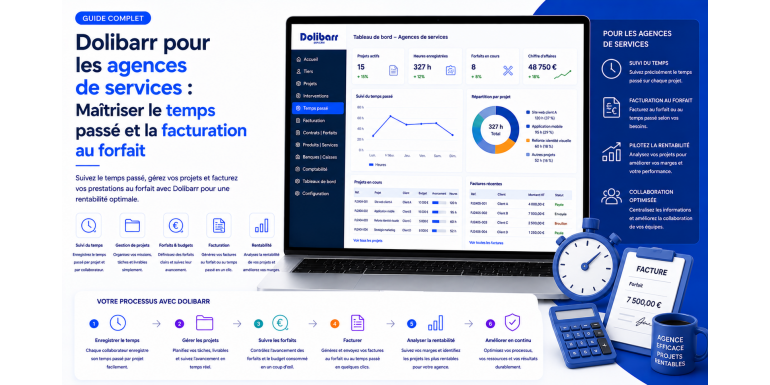
You run a consulting firm, a digital agency, an expert practice, an IT services company, a creative studio, a design office, or a business services structure. Your business is not about selling products, but about selling time, expertise, and intellectual capital. Your team members bill their hours or commit to flat-rate engagements, your clients measure you on deliverable quality and deadline mastery, your profitability depends on the ratio between hours sold and hours actually consumed. And yet, many agencies still pilot this fine mechanism with spreadsheets, scattered tools, and end-of-month intuition.
Dolibarr, properly configured for service agencies, offers a complete response to this demanding business. It manages missions, contracts, flat-rate engagements, time entry, analytical allocation, periodic billing, and margin analysis by employee, client, and project. Well configured, it becomes the heart of your commercial and operational steering. In this guide, NEXT GESTION shares the methodology it deploys with its agency clients to fully master time tracking and industrialize flat-rate, time and materials, or hybrid billing.
Table of Contents
- The Specific Challenges of Service Agencies
- Modeling Your Offering in Dolibarr
- Time Tracking: The Cornerstone of Profitability
- Flat-Rate, Time and Materials, Subscription: Choosing the Right Model
- Configuring Flat-Rate Billing in Dolibarr
- Configuring Time and Materials Billing
- Managing Recurring Contracts and Subscriptions
- Tracking Flat-Rate Consumption in Real Time
- Measuring Profitability by Mission, Client, and Employee
- Reporting and Agency Steering
- Quotes, Proposals, and Conversion Rates
- Useful Integrations for Agencies
- Daily Best Practices
- Frequent Mistakes to Avoid
- NEXT GESTION Support for Agencies
- FAQ: Frequently Asked Questions from Service Agencies
1. The Specific Challenges of Service Agencies
A service agency sells qualified human time. This evidence hides a demanding economic mechanism. Each hour of your employee has a loaded cost that includes salary, contributions, leave, training, and share of structural costs. This loaded hourly cost is the reference data from which your pricing is built. Selling at a price that comfortably covers this loaded cost is the foundation of your profitability; selling below, even occasionally, erodes your margin at silent speed.
Layered on this mechanism is the notion of utilization rate, sometimes called billing rate. A team member spends part of their time on billable missions, another part on non-billable internal activities: meetings, training, pre-sales, administrative management. The higher the utilization rate, the more profitable the firm. Fine tracking of the breakdown between billable and non-billable hours is therefore strategic data, which many agencies unfortunately pilot blindly.
Then comes the diversity of billing models. Some missions are billed by time spent, at an average daily rate or hourly rate. Other missions are sold as flat-rate, with a deliverable and a price defined in advance, regardless of time actually consumed. Still others rest on a monthly or annual subscription giving rights to a volume of hours, unlimited assistance, or regular presence. The same client may combine several models according to project phases. Your management tool must therefore handle these three models, and even hybridize them.
Finally, the value of an agency is also measured by the quality of its client relationship. Regular reviews, steering meetings, progress reports, structured deliverables, and decision traceability are all elements that build loyalty and differentiate. A well-configured Dolibarr serves this relationship quality by centralizing history, automating reminders, and equipping activity reviews.
2. Modeling Your Offering in Dolibarr
The first step is to properly model your commercial offering in Dolibarr. This modeling conditions the coherence of everything that follows. You create your services, your employee profiles, your daily rates, your standard flat-rate engagements, and your contract templates.
For services, create each recurring service you sell. Audit, support, training, development, workshop facilitation, regulatory expertise, study, design, change management. Each service carries a natural sale unit, which may be hour, day, flat-rate, work unit, or subscription. This categorization will serve for quotes, billing, and analysis.
For employee profiles, structure your team by skill and seniority levels. Junior, confirmed, senior, expert, director. Associate each profile with a loaded hourly cost and an average daily sale rate. This double grid allows mechanical calculation of the theoretical margin of each proposal and each mission, without manual recalculation.
Define your standard flat-rate engagements. A complete GDPR audit, a one-day Dolibarr training, an SEO optimization package, migration support. Each of these engagements is codified with a fixed sale price, a forecast duration, and a typical deliverable. Standard engagements accelerate quote production, guarantee price consistency, and facilitate the industrialization of repetitive missions.
Then create the recurring contract templates: monthly subscriptions, support contracts, maintenance contracts, unlimited assistance contracts. The Dolibarr contracts module allows automatic generation of associated periodic billing and tracking of services consumption under contract.
Finally, configure your sources of derived products: resold software licenses, travel expenses, specific purchases for the client. This clear structuring avoids omissions and facilitates justification of amounts in billing.
3. Time Tracking: The Cornerstone of Profitability
Time tracking is the technical base on which all indicators of a service agency rest. Without rigorous tracking, no profitability measurement, no utilization rate analysis, no precise billing of time spent. Dolibarr has a native dedicated module, supplemented by several extensions and mobile applications that facilitate daily use.
The principle is simple: each employee enters daily, or at the end of the week, the time spent on each mission, task, or internal activity. The granularity of tracking depends on your business: some agencies work at the quarter-hour for support missions, others at the half-day for consulting missions. The essential is to define a clear rule and apply it systematically.
To facilitate entry, Dolibarr offers a weekly timesheet interface presenting the list of projects and tasks assigned to the employee, with one column per day to fill. This entry can be done in real time, at the end of each day, or at the end of the week. Real-time entry is the most precise but requires discipline; weekly entry is faster but loses in precision. Several internal studies conducted by NEXT GESTION show that daily entry generates reliable data at ninety-five percent, against seventy-five percent for weekly entry done Friday evening.
Tracking must distinguish several categories of hours. Billable hours correspond to an identified client mission and will contribute to billing. Internal hours group non-billable activities: pre-sales, internal training, team meetings, administrative management. Absence hours cover leave, sick days, public holidays. This typology allows immediate calculation of the theoretical and billable utilization rate.
For flat-rate missions, time tracking plays an even more crucial role since it feeds consumption monitoring. On a thirty-day flat-rate engagement, you want to know at any moment how many days have been consumed, how many remain, and whether the mission is on the planned trajectory or in drift. Without precise tracking, this monitoring is impossible and drifts are discovered at delivery, when it is too late to react.
NEXT GESTION supports its clients in establishing a tracking culture. This goes through technical configuration but also pedagogy with teams, definition of team rituals, and integration of entry into employees' daily tools. A well-conducted approach transforms time tracking from a chore into a natural reflex.
4. Flat-Rate, Time and Materials, Subscription: Choosing the Right Model
Before configuring Dolibarr, it is essential to clarify the three billing models used by service agencies. Each responds to a type of mission and carries its own profitability logic.
The flat-rate consists of selling a deliverable or defined scope for a fixed price, regardless of time actually consumed. It suits missions with clear scope and controlled risks: website redesign, audit, report delivery, packaged training. The flat-rate carries the advantage of readability for the client and potential margin for the agency when execution goes well. In return, the agency bears the drift risk: a derailed project erodes margin, even tipping into loss.
Time and materials consists of billing time actually spent, at an hourly or daily rate. It suits missions with evolving scope, incident interventions, recurring technical assistance, exploratory missions. Time and materials secures agency profitability but requires strong client trust and good budget management. It is often associated with a maximum cap, sometimes called ceiling or envelope, which reassures the client while leaving flexibility in scope.
Subscription consists of billing periodically a fixed amount against a volume of services or availability. Monthly application maintenance, community management, user support, managed hosting, expert panel subscription. Subscription brings precious recurrence in terms of cash flow and predictability, and facilitates internal planning. Its success supposes clear scope framing and rigorous tracking of consumption to avoid silent drift.
Many agencies combine these models. A mission may start with an audit flat-rate, continue with implementation time and materials, then switch to maintenance subscription. Dolibarr allows managing this combination under the same project or client, clearly distinguishing each billable line and its economic mode.
5. Configuring Flat-Rate Billing in Dolibarr
Flat-rate billing in Dolibarr follows seemingly simple logic but requires some configuration precautions to function fully.
At launch, the flat-rate is materialized by a quote or commercial proposal detailing deliverables, milestones, and total price. This quote is then transformed into a customer order once signed. The project associated with the order becomes the receptacle of all activities linked to the flat-rate: time spent, purchases, subcontracting, deliverables.
Billing can be configured according to several cadences. Billing on order for a launch deposit, followed by milestone billings during execution, then a final billing at delivery. Monthly periodic billing, independent of actual progress, which smooths cash flow. Progress billing, based on declared and validated percentages. The choice depends on flat-rate duration, client culture, and your cash flow strategy.
To pilot flat-rate profitability, you enter in the project the forecast budget in days per profile and value budget. Through tracking, Dolibarr calculates cumulative consumption and compares it to budget. A good practice is to set up an alert threshold, for example at eighty percent consumption, which triggers a steering review with the project manager and management. This threshold acts as an immune system against silent drifts.
Tracking the remaining work is the other key flat-rate indicator. It involves estimating, at a given moment, the number of days still needed to complete the mission. If cumulative consumed plus remaining exceeds sold budget, you are drifting and it is time to act. This estimate can be entered manually by the project manager or fed by task management tools connected to Dolibarr.
NEXT GESTION recommends setting up a monthly steering committee on flat-rates over fifteen days, led by the production director with project managers, based on Dolibarr indicators. This steering ritual drastically reduces average drift and increases flat-rate net margin over the year.
6. Configuring Time and Materials Billing
Time and materials consists of billing time actually consumed. Its configuration in Dolibarr rests on three elements: an average daily or hourly rate associated with the employee or mission, precise time tracking, and a periodic billing mechanism based on tracked hours.
The average daily rate, or ADR, can be defined several ways. Either a unique ADR per employee profile, applicable to all missions. Or a specific ADR negotiated by contract with a client, which prevails over the standard ADR. Or an ADR per mission, allowing mixing several profiles on the same project. Dolibarr supports this flexibility through time module and contract parameters.
Time and materials billing classically occurs at the end of each month. The process is as follows: extraction of hours tracked over the period, control and validation by the project manager, generation of an invoice detailing hours by employee, by task or by day, application of the ADR, and issuance. Dolibarr allows automating this mechanism with customized invoice templates and configured extractions.
For capped time and materials, also called engaged time and materials, you set an hour ceiling or budget ceiling that must not be exceeded without client agreement. Dolibarr allows tracking this ceiling in real time and generating an alert when a defined threshold is crossed. This discipline reassures clients and avoids end-of-month billing conflicts.
Transparency is one of the major assets of time and materials. A good Dolibarr produces for each monthly invoice a detail of hours consumed, readable by the client, materializing delivered value and facilitating acceptance. This detail is generally attached to the invoice, as a table or weekly report.
7. Managing Recurring Contracts and Subscriptions
Recurring contracts are a goldmine for service agencies. They bring predictable revenue, build client loyalty, and smooth production. Dolibarr has a robust contracts module allowing proper management.
Each contract is created in Dolibarr with its start date, end date, billing periodicity, amount, and list of services it covers. Monthly, quarterly, or annual, the contract automatically triggers invoice generation at the defined deadline. You validate and then send the invoice, and the operation is traced.
For contracts with included hour volume, for example five days per month of assistance, Dolibarr allows associating consumption with hours tracked on the client's projects. Beyond the included volume, additional hours are billed in addition, at an ADR defined in the contract. This mechanism secures recurring revenue while valuing overruns.
Management of tariff revisions is one of the classic challenges of recurring contracts. An annual revision indexed on inflation or a business index is common in agencies. Dolibarr allows planning these revisions, notifying the client in advance, and applying the new tariff on the scheduled date, without breaking the billing mechanism.
Tracking attrition, or churn rate, is a strategic indicator for agencies with recurrence. How many contracts are terminated each quarter, at what value, for what reasons. Dolibarr allows tracking these terminations and analyzing them to adjust your offering and client relationship.
NEXT GESTION supports its clients in structuring a recurring offering, from package design to billing industrialization and satisfaction tracking. The recurring revenue share is a marker of agency maturity and a valuation lever.
8. Tracking Flat-Rate Consumption in Real Time
Real-time consumption tracking is one of the functions where Dolibarr, well configured, makes the difference for agencies. Rather than discovering at mission end that the budget has exploded, you see each week where you stand and can act.
A flat-rate dashboard typically displays the sold budget in days and value, cumulative consumed to date, remaining estimated to complete, forecast variance, and a visual project health indicator. A green project is on track, an orange project requires a steering review, a red project requires a decision: amendment, scope adjustment, method optimization, or acceptance of degraded margin.
To function, this dashboard requires three conditions. First, budgets entered in Dolibarr at mission launch. Second, regular and reliable time tracking. Third, weekly update of remaining work by the project manager. These three conditions are within reach of any motivated agency and form the foundation of data-driven steering.
For agencies running dozens of missions simultaneously, a consolidated view is precious. Dolibarr allows displaying all active projects with, for each, health status, consumption rate, project manager, and client. This panoramic view guides trade-offs: where to concentrate supervisory efforts, which missions justify a client alert, which missions can absorb additional load.
9. Measuring Profitability by Mission, Client, and Employee
The real profitability of an agency is measured at several levels. Dolibarr, fed by time tracking and allocated purchases, allows producing these analyses reliably and automatically.
At the mission level, profitability is calculated by comparing mission revenue to the cost of hours actually consumed, augmented by specific allocated purchases. The delta gives gross margin. This gross margin, related to revenue, gives margin rate. Historical analysis on all closed missions extracts average margin rate, median, and distribution. You identify profitable standard missions and at-risk missions.
At the client level, profitability aggregates all missions and subscriptions of the client over a period. Some high-revenue clients prove little profitable because they consume many non-billable hours: meetings, adjustments, out-of-scope requests. Conversely, some medium-revenue clients display remarkable margins. This fine analysis guides commercial strategy: which clients to develop, which to renegotiate, which to abandon.
At the employee level, profitability is measured by billable utilization rate and margin generated on missions they contributed to. This analysis helps guide employee development, mission assignment, and evolution. It also feeds annual performance reviews.
NEXT GESTION designs for its clients aggregated dashboards crossing these three dimensions and feeding monthly management committees. An agency that pilots by data distinguishes itself from one that pilots by intuition, and the differential shows at year-end in net result.
10. Reporting and Agency Steering
Beyond profitability measurement by dimension, Dolibarr feeds a set of indicators structuring service agency steering.
The billable utilization rate is the cardinal indicator. It measures the proportion of billable hours in total tracked hours excluding absences. A rate above eighty percent translates a highly solicited team, sometimes overloaded. A rate below sixty-five percent signals a commercial deficit or skills underuse. The target varies by trade and model, but monthly tracking is universal.
The order book measures revenue sold but not yet invoiced, giving visibility on coming weeks and months. An order book below one month translates tense situation; an order book above three months reassures but may reveal understaffing.
Quote conversion rate indicates commercial efficiency. How many issued quotes transform into orders, in what average time, at what value. Fine tracking by mission type, by sales rep, and by client identifies improvement levers.
Client outstanding measures issued and not yet paid invoice value, breakdown by age. Lengthening outstanding fragilizes cash flow and calls for reminder or collection actions. Dolibarr offers automated reminder functions industrializing this management.
The skills pyramid informs on team composition by profile and seniority. Compared to needs forecast in upcoming missions, it helps plan recruitments or training.
11. Quotes, Proposals, and Conversion Rates
For an agency, the quote is a commercial and technical expertise exercise. It involves accurate pricing, presenting a convincing approach, and differentiating. Dolibarr offers all tools to support this exercise.
Quote construction takes place in two phases. An internal estimation phase, where the project manager builds the costing in days by profile, based on standard flat-rates, similar past missions, and estimation specific to the demand. A commercial formatting phase, where the quote is dressed up, presented, and supplemented by an approach note, references, and general conditions. Dolibarr allows generating structured quotes in lots, with options and variants.
For high-value missions, the commercial proposal takes the form of a more elaborate document than a simple quote: team presentation, methodology, deliverables, planning, conditions, price. Dolibarr allows managing these proposals as rich files, with versions, internal validations, and traced sending.
Commercial tracking of quotes operates in Dolibarr through a classic pipeline: issued, in discussion, in negotiation, signed, lost. For each quote, you note interactions with the prospect, objections, response arguments. This trace feeds conversion rate analysis and continuous improvement of commercial speech.
NEXT GESTION supports its agency clients in writing model proposals, configuring the commercial pipeline, and conducting weekly pre-sales reviews. Commercial quality is a growth lever often underinvested compared to operations.
12. Useful Integrations for Agencies
Dolibarr fits in an ecosystem of tools agencies use daily. Well-thought integrations strengthen its value without overloading it.
Integration with a task management tool like Trello, Jira, Asana, or ClickUp allows linking time tracking to operational tasks. The employee enters time where they already work, and data flows up to Dolibarr for billing and steering.
Integration with a business messaging tool like Slack or Microsoft Teams allows notifying the team of key events: new signed order, flat-rate overrun alert, quote to validate, late invoice. These notifications maintain attention on indicators without imposing manual consultation.
Integration with an accounting tool or accountant industrializes entry transfer and frees administrative time. Issued invoices and supplier invoices are exported in standard format and automatically picked up in accounting, without double entry.
Integration with an electronic signature tool fluidifies signed quote returns and accelerates order transition. Contracts are signed in minutes rather than days.
Integration with a prospecting tool or advanced CRM allows feeding Dolibarr with qualified prospects and structuring upstream commercial relationship. Dolibarr then becomes the central point of prospect-to-billed-client transformation.
NEXT GESTION designs for its clients coherent architectures where each tool plays its role and Dolibarr occupies the operational and financial pivot place.
13. Daily Best Practices
Beyond configuration, an agency's effectiveness under Dolibarr depends on a few daily best practices, simple but cumulatively decisive.
Enter times every day. A daily ten-minute evening entry is worth more than a rushed Friday-evening weekly entry. Data is more precise, memory is fresh, steering is reliable.
Validate timesheets each week. The project manager or manager reviews team entries, validates or questions, corrects errors. This quick validation avoids heavy end-of-month corrections.
Hold a monthly project review. With the production director, go through each active project: progress, consumption, alerts, risks, deliverables. Thirty minutes per project, multiplied by ten projects, far outweigh the dramas avoided.
Issue invoices as soon as service is due. Any issuance delay is a cash flow delay, sometimes a pure omission. The billing calendar must be held like an industrial calendar.
Follow up on late invoices without delay. An unfollowed payment delay becomes chronic. Dolibarr offers automatic email reminders, modular and customizable.
Hold a weekly cash flow point. In one hour, you review outstanding, delays, expected payments, upcoming charges. This discipline anticipates tensions.
Document missions. Each completed mission feeds your knowledge base: actual duration, variances, difficulties, deliverables. This collective memory improves future quotes.
14. Frequent Mistakes to Avoid
A few mistakes recur frequently among agencies starting with Dolibarr and deserve mention.
First mistake: not instituting rigorous time tracking. Without tracking, no indicator is reliable, and analytics remain theoretical. Time tracking setup is non-negotiable.
Second mistake: not entering mission forecast budgets. Without budget, no consumption tracking, no drift alert. Budget is the measurement standard.
Third mistake: mixing billable and non-billable hours. The distinction must be clear in tracking. Wrong assignment skews utilization rate calculation and masks real costs.
Fourth mistake: underestimating ADR revision. An ADR set three years ago no longer reflects inflation, nor evolution of your loaded cost. Annual revision is healthy.
Fifth mistake: not analyzing closed missions. Each completed mission carries lessons. Ignoring them means repeating the same mistakes.
Sixth mistake: neglecting document management. Deliverables, reports, structuring emails must be attached to the project in Dolibarr. This traceability protects the agency and secures client relationships.
Seventh mistake: underusing recurring contracts. An agency resting one hundred percent on punctual missions lives in revenue rollercoaster. Developing a recurring part changes the equation.
15. NEXT GESTION Support for Agencies
NEXT GESTION has supported more than a hundred agencies in setting up and optimizing their Dolibarr. Our approach is structured around five complementary stages.
The initial audit maps your economic model, mission types, employee profiles, contracts, production processes, and existing tools. It identifies strengths, fragilities, and priority value zones.
Design defines the Dolibarr target: activated modules, project structure, ADR grid, quote and invoice templates, periodic billing mechanism, key indicators. This target is validated with your management committee.
Implementation configures the application, migrates existing data, configures users, sets up templates, tests flows. A receipt is conducted with your business referents to validate that Dolibarr properly covers your needs.
Training prepares all your teams: salespeople, consultants, project managers, accountants, executives. Modules adapted to each profession guarantee appropriation and effective use.
Continuous support follows you over time. Application maintenance, version upgrades, module addition, performance audits, strategic advice. You benefit from a partner who knows your agency business and your instance in detail.
If you run a service agency and wish to professionalize your steering with Dolibarr, NEXT GESTION is at your side to transform your tool into a lasting competitive advantage.
16. FAQ: Frequently Asked Questions from Service Agencies
Is Dolibarr really suited to a service agency? Yes, provided it is well configured. The Dolibarr standard covers the basics: projects, times, quotes, invoices, contracts. Adapted configuration and a few complementary modules allow covering all agency specifics, from consulting firms to IT services companies.
How long does it take to deploy Dolibarr in an agency? Depending on size and complexity, complete deployment takes between four and twelve weeks. An agency of less than ten employees can be operational in one month; a fifty-person agency with sector specifics requires two to three months.
Can time tracking be done from a mobile? Yes. Several Dolibarr-compatible mobile applications allow mobile entry, in client meetings, on the move. Entry is thus instantaneous and data more reliable.
How to manage a client who does not want to see hour detail? Dolibarr allows producing invoices with different detail levels. For clients wanting discretion, you bill a synthetic wording without hour detail. Detail remains internal for steering.
Can mission profitability be tracked in real time? Yes. With regular tracking, the mission dashboard displays in real time cumulative consumed, estimated remaining, and forecast margin. You pilot profitability without waiting for closing.
What is the difference between capped time and materials and flat-rate? Capped time and materials bills hours actually consumed within a ceiling; unused hours are not billed. Flat-rate bills a fixed price regardless of time consumed. Time and materials is more secure for the budget-conscious client, flat-rate is more predictable.
How to integrate Dolibarr with my task management tool? Several connectors and bridges exist for Trello, Jira, Asana, ClickUp, and Monday. NEXT GESTION designs integrations adapted to each agency's context.
Does Dolibarr allow managing external expert subcontracting? Yes. Subcontractors are created as suppliers, their interventions are allocated to client projects, their invoices are reconciled with projects. The net mission margin integrates these costs.
Article written by NEXT GESTION, Dolibarr expert and partner of service agencies in the digitalization of their operational and commercial steering. Are you running an agency and wish to optimize your time and billing management with Dolibarr? Contact our consultants: contact@nextgestion.com.