
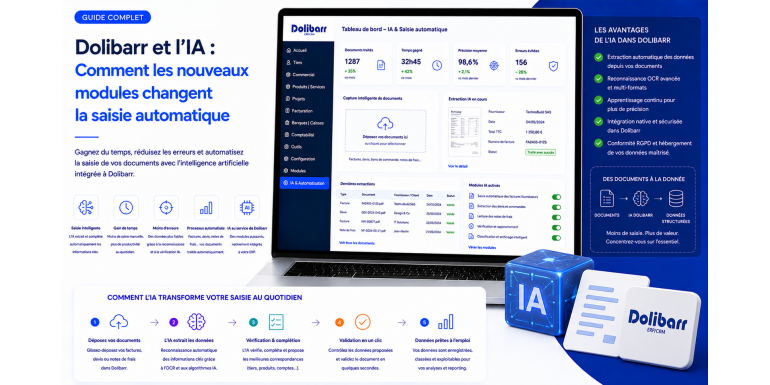
Artificial intelligence has left the world of research and large platforms to enter the daily lives of SMEs. In 2026, it now invites itself to the heart of ERPs like Dolibarr, transforming tasks that until recently occupied hours of manual entry. Reading a supplier invoice received by email, creating the corresponding third party record, accounting allocations of amounts, classifying the document in the right folder: all operations that can now be performed in seconds thanks to AI modules installable on any Dolibarr. This silent revolution changes not only administrative productivity but also opens new possibilities for analysis, forecasting and user assistance.
For executives and administrative managers operating a Dolibarr, understanding these evolutions becomes strategic. Early users observe productivity gains ranging from forty to seventy percent on certain repetitive tasks, strongly improved data quality and a usage comfort that transforms team relationships with their ERP. But AI is not a magic wand. Its integration requires pertinent technical choices, reflection on data confidentiality, user training and rigorous quality monitoring. In this guide, NEXT GESTION shares its experience of the first AI deployments in Dolibarr with its clients, the available modules, use cases that bring real value and pitfalls to avoid.
Table of Contents
- AI in ERPs in 2026: Where Do We Really Stand
- The Technology Building Blocks Underlying AI in Dolibarr
- Intelligent OCR of Supplier Invoices
- Automatic Document Classification
- Automatic Creation of Third Party Records from Email
- AI-Assisted Accounting Entry
- Quote and Commercial Proposal Writing
- Conversational Assistants Integrated into Dolibarr
- Sales Forecasts and Anomaly Detection
- Intelligent Customer Reminders Management
- AI Modules Available on Dolistore
- Choosing an AI Provider: Cloud or Local
- Confidentiality and GDPR Challenges
- The Cost of AI in Dolibarr
- Best Practices for Successful AI Integration
- Current Limits of AI in an ERP
- NEXT GESTION Support for Dolibarr AI
- FAQ: Frequently Asked Questions About AI in Dolibarr
1. AI in ERPs in 2026: Where Do We Really Stand
In 2026, artificial intelligence in ERPs is no longer a marketing promise but an operational reality. Major publishers like SAP, Oracle, Microsoft Dynamics have integrated AI features into their premium cloud versions, often in the form of conversational copilots. On the open source side, Dolibarr follows the same dynamic, but with a notable advantage: the platform's modularity allows different publishers to offer specialized AI integrations, accessible via Dolistore and deployable without a major version upgrade.
The technical context has profoundly changed in the last two years. Large language models like GPT-4 and its successors, Claude, Gemini or Mistral, now reach a level of natural language understanding that makes possible use cases previously inconceivable. Optical character recognition, or OCR, has made a spectacular qualitative leap thanks to next-generation computer vision architectures. These models can read invoices in any format, understand their structure even if unusual, and extract relevant data with near-perfect precision on clean documents.
For Dolibarr, this evolution translates into several successive integration waves. The first wave, which started in 2023, brought the first OCR functions on supplier invoices. The second wave, in 2024 and 2025, added automatic classification, writing assistance and the first conversational interfaces. The third wave, which begins in 2026, goes much further: personalized assistants per user, intelligent forecasts, automations based on learned rules, multimodal integrations with voice and image data.
For SMEs using Dolibarr, the issue is no longer whether AI will arrive in their ERP, but how to adopt it intelligently, at what pace and with what safeguards. This structuring choice determines not only achievable productivity gains, but also the competitive positioning of the company in the years to come.
2. The Technology Building Blocks Underlying AI in Dolibarr
Artificial intelligence in Dolibarr doesn't come out of nowhere. It relies on several technology building blocks that are useful to understand to make the right choices.
Large Language Models, or LLMs, are at the heart of the current revolution. They allow understanding and generating natural language text, classifying content, answering questions, drafting documents. The main players are OpenAI with GPT, Anthropic with Claude, Google with Gemini, Mistral in Europe, Meta with Llama for open source models. Each has its strengths: response quality, speed, cost, supported languages, multimodal capability.
Computer vision models process images and scanned documents. They are used for advanced OCR, table structure recognition, identification of elements in images. Recent models understand not only text but also layout, which radically changes the quality of extraction of invoices and delivery notes.
Integration APIs allow Dolibarr to communicate with these external models. Main providers offer standardized APIs that accept a request and return a result. This modularity allows Dolibarr modules to switch between providers or combine several AIs according to needs.
Retrieval-augmented generation techniques, or RAG, allow language models to respond by relying on your Dolibarr data. Rather than responding only with general knowledge, the AI will first look in your database for relevant information, then formulate an adapted response. This technique makes possible business conversational assistants.
Autonomous agents represent the most recent frontier. These systems can chain several actions autonomously to accomplish a complex task: read an email, create a third party record, generate a quote, send a reply. This deep automation opens perspectives but requires attentive supervision to avoid drift.
NEXT GESTION combines these building blocks according to each client's needs, favoring mature solutions and use cases with high return on investment.
3. Intelligent OCR of Supplier Invoices
OCR of supplier invoices is probably the most mature and profitable use case of AI in Dolibarr. It transforms a tedious and time-consuming task into a quick validation operation.
The principle is simple. Your supplier invoices arrive by email, scan or download from a portal. Rather than being manually entered into Dolibarr, they are analyzed by an AI module that automatically extracts key information: supplier name, invoice number, date, net amounts, VAT rates and amounts, gross total, order references, line labels. This data pre-fills a supplier invoice record in Dolibarr, ready to be validated by a user.
Measurable gains are significant. Where manual entry of an invoice typically takes between two and five minutes depending on complexity, intelligent OCR reduces this operation to thirty seconds of verification. For an SME processing one hundred supplier invoices per month, this equals several days of work freed up. For larger structures, the impact is counted in person-months.
Extraction quality varies according to document nature. On well-formatted invoices, correct extraction rate regularly reaches ninety-five percent. On handwritten or poor quality documents, this rate decreases but remains largely superior to classic manual entry. The most advanced modules learn over time the specificities of your recurring suppliers and progressively improve their precision.
An often-neglected point is the automatic creation of the supplier record if it doesn't exist. The module identifies the company registration number or VAT number in the invoice, checks if the supplier is already in the database, and creates the complete record with all legal information if necessary. This automation removes another point of administrative friction.
NEXT GESTION systematically recommends this first use case to its clients to start their AI journey. Return on investment is rapid, risks are limited, and experience prepares well for the adoption of other modules.
4. Automatic Document Classification
Beyond OCR itself, AI allows automatic classification of documents arriving in your Dolibarr. This classification streamlines the entire administrative flow.
When a document enters the system, by email or deposit, AI analyzes its content and orients it to the right category: supplier invoice, rejected customer invoice, signed customer quote, delivery note, certificate, contract, commercial correspondence. Each document type triggers an adapted workflow: integration into Dolibarr, notification of the right user, archiving, task triggering.
Benefits of this classification are multiple. First, documents always arrive in the right place without human intervention. Second, processing delays are reduced because notifications go out immediately. Third, traceability is reinforced because each document is correctly labeled and archived.
Technically, classification combines several techniques. Text content analysis via an LLM allows understanding document nature. Layout recognition identifies structural elements. Business rules configured in Dolibarr orient the final classification. This combination makes the system both precise and adaptable to your specificities.
For structures receiving a large volume of emails mixing invoicing, sales, support and others, upstream automatic classification can represent considerable productivity gain for the administrative service. NEXT GESTION supports its clients in defining relevant categories and configuring associated workflows.
5. Automatic Creation of Third Party Records from Email
AI also simplifies the creation of customer and supplier records from information scattered in received emails and documents.
Imagine the scenario: a prospect sends you an email to request a quote. Their signature contains their name, function, company name, phone, postal address. Rather than manually copy-pasting this information into Dolibarr, an AI module can extract this data, identify the company in reference databases, automatically complete with the company registration number, VAT number and official address, and create the complete record in seconds.
This automation has several advantages. Data quality is immediately superior because legal information is retrieved from official sources rather than manually entered. Duplicates are avoided because the system checks prior existence of the company. Time saved is significant, especially for salespeople who can focus on their core business rather than administrative entry.
For suppliers, the mechanism is similar but typically applies to the first invoice received. AI extracts supplier contact information, checks its existence in the database, completes missing information, and creates the ready-to-use record.
This function is particularly appreciated by sales teams and purchasing services who see their administrative load decrease significantly. NEXT GESTION integrates this automation in the majority of its AI deployments.
6. AI-Assisted Accounting Entry
Accounting entry is one of the most time-consuming tasks in an SME. AI can significantly lighten it by automatically proposing accounting allocations.
When a supplier invoice is entered into Dolibarr, whether from OCR or manual entry, the AI module analyzes its content and proposes the accounting accounts to use. For an IT equipment purchase invoice, the module proposes the appropriate account depending on nature and amount. For travel expenses, it orients toward expense accounts. For service provisions, it chooses between purchase and external service accounts according to context.
AI learns from accountant choices over time. If you habitually allocate a recurring supplier's invoices to a specific account, the module retains this practice and applies it automatically to subsequent invoices. This learning makes the system increasingly pertinent over its use.
For commercial records, AI can suggest the new customer's market segment, their probable business code, their favorite product family from first interactions. These suggestions accelerate commercial qualification and improve data reliability.
For VAT, AI controls consistency between the applied rate and the nature of the product or service, alerting on anomalies. This automatic verification reduces errors and facilitates fiscal compliance.
NEXT GESTION observes with its clients that AI-assisted accounting entry reduces by fifty to seventy percent the time devoted to this task while improving allocation quality. It's a use case with very strong return on investment.
7. Quote and Commercial Proposal Writing
AI also transforms the writing of quotes and commercial proposals, accelerating a traditionally long and tedious process.
From a short brief, AI can generate a proposal framework including understanding of customer need, presentation of your approach, service details, indicative schedule, general conditions. This framework, which normally takes several hours to draft, is produced in minutes by AI, ready to be personalized by the salesperson.
For service agencies, design offices and structures that regularly respond to tenders, this time savings is considerable. Where a commercial proposal required half a day from a consultant, it can now be prepared in less than an hour of work, keeping the same final quality thanks to human review.
AI can also rely on your proposal history to propose content aligned with your style and practices. If your previous proposals highlighted certain arguments, references, methodologies, AI reuses them in new proposals to maintain image consistency.
For quoted estimates, AI can suggest a standard breakdown based on similar projects you have already completed, with workload estimates per employee profile. The salesperson validates and adjusts these estimates rather than starting from a blank page.
Watch however for an important point: writing by AI must always be reviewed and personalized by a human. A proposal sent without review risks containing approximations or inconsistencies that hurt your credibility. NEXT GESTION systematically recommends a workflow where AI produces a draft that the salesperson validates and enriches.
8. Conversational Assistants Integrated into Dolibarr
One of the most notable evolutions in 2026 is the appearance of conversational assistants integrated into Dolibarr. These copilots allow interacting with the ERP in natural language, opening usage to profiles that did not use Dolibarr before.
Concretely, a user can ask questions like: what is March revenue, which customers haven't ordered in three months, how many quotes are awaiting signature, what is my margin on current projects. The assistant queries the Dolibarr database, formulates a natural language response and possibly displays a relevant table or chart.
This conversational interface transforms access to information. Rather than navigating complex menus or asking a referent to produce a report, each user can directly obtain the data they seek. This autonomy democratizes ERP usage and improves piloting quality.
The assistant can also execute actions on demand. Create a quote for a given customer, schedule a reminder, add a task in a project, send a template email: all actions that can be triggered by a simple phrase. This natural interaction reduces friction and accelerates execution.
Personalization per user is the most recent evolution. The assistant knows your role, your usual customers, your preferences, your business vocabulary. It adapts its responses and suggestions to your specific context, making it increasingly useful over use.
Several conversational modules are now available in the Dolibarr ecosystem, with varying levels of maturity. NEXT GESTION supports its clients in choosing and deploying these assistants by prioritizing security and business relevance.
9. Sales Forecasts and Anomaly Detection
Beyond entry and assistance, AI brings advanced analytical functions that transform piloting quality.
Sales forecasts use Dolibarr history to anticipate future revenues. AI analyzes seasonalities, trends by customer segment, recurring purchase behaviors and produces projections at one month, three months, six months. These forecasts, more reliable than human estimates for major trends, feed commercial and financial piloting.
Anomaly detection continuously monitors your Dolibarr data to spot unexpected discrepancies. A supplier invoice of unusual amount, a customer payment delay that abnormally lengthens, an order that exits a customer's usual standards: AI alerts on these anomalies before they become problematic. This automated vigilance strengthens operational risk management.
Predictive churn analysis identifies customers at risk of leaving. By cross-referencing revenue evolution, order frequency, payment delays, support interactions, AI detects weak signals announcing disengagement. Sales teams can then act preventively rather than discovering departure after the fact.
Stock optimization uses past sales and forecasts to suggest optimal stock levels. This optimization limits both stockouts that penalize sales and overstocks that weigh on cash flow.
These advanced analytical functions were previously reserved for large companies with data teams. AI now makes them accessible to SMEs via affordable Dolibarr modules.
10. Intelligent Customer Reminders Management
Customer reminder management is another use case where AI brings significant gain. Rather than sending uniform automatic reminders, AI adapts tone and content according to the context of each invoice.
For a good payer with unusual delay, AI proposes a courteous message assuming oversight. For a customer accumulating delays, tone hardens progressively. For a customer with known difficulty, AI rather suggests phone contact. This personalization increases recovery rate while preserving commercial relationship.
AI can also analyze reminder response emails to understand objections and respond to them. If a customer reports a delivery problem, the system can route the file to the sales administration. If a customer disputes the amount, the file goes up to the salesperson. This automatic orientation accelerates special case processing.
For structures with a high number of outstanding invoices, intelligent reminder management can transform the average payment delay and therefore cash flow. NEXT GESTION supports its clients in defining reminder rules and calibrating AI according to their commercial strategy.
11. AI Modules Available on Dolistore
Dolistore offers in 2026 an increasing variety of modules integrating AI in Dolibarr. The choice can seem complex but a few families structure the offering.
Invoice OCR modules are the most mature and numerous. They are distinguished by extraction quality, supported languages, handling of special cases like multi-page invoices or expense reports. Some are sold with monthly volume included, others bill per transaction.
Content generation modules rely on LLMs to draft emails, product descriptions, reports, product sheets. Their quality depends on the underlying model and business configuration.
Conversational modules bring a chat interface connected to your Dolibarr data. They differ by integration depth, possible personalization and AI provider used.
Analytical modules produce forecasts, detect anomalies, suggest commercial actions. Their value largely depends on the quality of historical data available in your Dolibarr.
Automation modules orchestrate sequences of actions triggered by events. Reading an email, creating a quote, sending a reply, updating a status: all actions that can chain automatically.
NEXT GESTION regularly audits new Dolistore AI modules and recommends to its clients those combining reliability, relevance and economy.
12. Choosing an AI Provider: Cloud or Local
A structuring decision in any Dolibarr AI project is the choice between cloud solutions, where data is processed on provider servers, and local solutions, where AI runs on your own infrastructure.
Cloud solutions, based on OpenAI, Anthropic, Google or Mistral APIs, offer the most powerful and up-to-date models. Their integration is simple and entry cost is low. In return, data processed transits through external servers, raising confidentiality and localization questions for certain sensitive companies.
Local solutions, based on open source models like Llama, Mistral or specialized derivatives, run on your own server or on a server hosted in European datacenter. They offer complete data control but require heavier infrastructure and sometimes less performant models than best proprietary models.
A hybrid approach also develops, where some sensitive treatments go through local AI and others through cloud AI according to required confidentiality level. This hybridization optimizes the quality-confidentiality compromise.
The choice depends on several factors: nature of your data, regulatory constraints of your sector, available budget, internal technical skills. NEXT GESTION advises its clients case by case and proposes architectures adapted to each context.
13. Confidentiality and GDPR Challenges
Integrating AI into Dolibarr raises important confidentiality and GDPR compliance questions that must be treated seriously.
When you send a supplier invoice to a cloud OCR service, you transmit to a third party data about your purchases, business partners, prices. This sensitive information must be processed with appropriate guarantees. Verify provider server localization, contractual commitments regarding non-use of data, retention duration and deletion conditions.
GDPR imposes specific rules for automated treatments on personal data. If AI contributes to decisions with significant impact on persons, transparency and opposition right obligations apply. For Dolibarr usage, this mainly concerns customer behavioral analyses and automated reminder decisions.
Several technical precautions strengthen compliance. Pseudonymization of data before sending to AI, limitation of transmitted data to strict necessity, encryption of exchanges, regular audit of providers: as many measures that reduce risks.
Information of users and concerned persons is also important. Your customers must be informed that their data may be processed by AI systems, and your collaborators must understand the tools they use daily.
NEXT GESTION systematically integrates compliance challenges in its AI missions, with specific analysis for each use case and GDPR documentation support if necessary.
14. The Cost of AI in Dolibarr
Integrating AI in Dolibarr has a cost that must be anticipated, even if this cost is generally well below the gains realized.
Dolistore AI modules typically cost between one hundred and five hundred euros for the initial license, sometimes more for the most comprehensive modules. This license is often lifetime for one instance, with updates included for one or two years.
To this is added AI API usage cost, which is billed per transaction or processed volume. For invoice OCR, count between five and fifteen cents per processed invoice depending on provider. For requests to a conversational assistant, cost is on the order of a cent per request. On normal SME volume, monthly cost typically remains between fifty and three hundred euros per month.
Integration and configuration cost by an integrator like NEXT GESTION depends on project complexity. For a simple invoice OCR setup, count between one thousand and three thousand euros. For a complete deployment including several modules and customization, budget can reach ten to twenty thousand euros.
Total annual cost for a standard SME, integrating licenses, APIs and support, is typically between three thousand and ten thousand euros. Compared with productivity gains, often counted in tens of thousands of euros per year, return on investment is generally very favorable.
NEXT GESTION systematically provides transparent costing at project start, with return on investment calculation adapted to client context.
15. Best Practices for Successful AI Integration
A few best practices structure the success of an AI project in Dolibarr.
Start with a high return on investment use case. Supplier invoice OCR or automatic third party record creation generally offer fast and visible results, creating buy-in for subsequent phases.
Don't underestimate the configuration phase. A poorly configured AI module will give mediocre results and discredit the project. Invest the necessary time in calibration, business rules and quality controls.
Systematically maintain human supervision. AI assists, it does not replace human judgment for sensitive operations. Set up validation thresholds and consistency controls.
Measure results. Track indicators before and after implementation: average processing time, error rate, user satisfaction. These measures objectify gains and orient improvements.
Train users. A team that doesn't understand AI will use it poorly or reject it. Short but targeted training on concrete benefits for each profile radically changes adoption.
Iterate progressively. Rather than aiming for revolution in a single project, deploy AI in successive waves, consolidating each step before moving to the next.
Anticipate maintenance. AI evolves rapidly and your modules must follow. A maintenance contract with an experienced integrator ensures your Dolibarr stays up to date with the latest evolutions.
16. Current Limits of AI in an ERP
Despite spectacular progress, AI still presents limits that are important to know to calibrate expectations.
Variable quality according to documents remains a reality. On standard invoices from regular suppliers, OCR reaches excellent extraction rates. On unusual, handwritten or poor quality documents, errors remain. Human supervision remains necessary.
Hallucinations of language models can generate false information presented convincingly. A poorly calibrated conversational assistant may assert erroneous figures or invent data. RAG techniques limit this risk but don't completely eliminate it.
Dependence on external providers raises strategic questions. If your Dolibarr relies on third party APIs and that party changes prices, conditions or disappears, you are exposed. Redundancy and portability strategies should be anticipated.
GDPR compliance is complex and evolving. The European regulatory framework on AI is progressively enriching and your practices must follow. Regular legal monitoring is necessary.
User adoption is not guaranteed. Some teams embrace AI with enthusiasm, others resist out of fear or skepticism. Human support remains essential.
Model biases can reproduce stereotypes or errors present in their training data. Particular vigilance is needed on uses touching human decisions, like customer scoring or supplier selection.
Knowing these limits allows using AI measuredly and benefiting from its contributions without suffering its risks.
17. NEXT GESTION Support for Dolibarr AI
NEXT GESTION has significantly invested in AI integration in Dolibarr and today supports several dozen clients in this transformation.
The initial audit maps your current processes, identifies repetitive tasks with high automation potential and quantifies potential return on investment for each use case. This audit results in a prioritized AI integration roadmap.
Module selection relies on our permanent technological watch and our experience feedback. We rule out unstable modules or unreliable providers and favor proven solutions.
Technical integration is conducted by our specialized consultants. Installation, configuration, business calibration, tests: each step is documented and accepted.
User training is designed for each profile. Accountants, salespeople, executives receive adapted training combining general AI understanding and practical mastery of tools.
Indicator monitoring measures the real impact of AI: time saved, quality improved, user satisfaction. These measures feed adjustments and demonstrate return on investment.
Continuous maintenance, integrated into our contracts, ensures your AI stays up to date, performant and compliant. New features are evaluated and integrated at your pace.
If you wish to explore AI potential in your Dolibarr, NEXT GESTION accompanies you with rare expertise combining in-depth Dolibarr knowledge and mastery of AI technologies.
18. FAQ: Frequently Asked Questions About AI in Dolibarr
Is AI in Dolibarr reliable for accounting? For invoice extraction and allocation suggestion, AI reaches high reliability on standard cases. Human supervision remains necessary for special cases and final validation, which are the accountant's responsibility.
How much does setting up AI in my Dolibarr cost? For a standard SME, total annual cost is typically between three thousand and ten thousand euros including licenses, APIs and support. This cost is generally quickly amortized by productivity gains.
Is my data secure with AI? Security depends on the chosen AI provider and configuration. Serious cloud solutions offer solid contractual guarantees. Local solutions guarantee maximum confidentiality at the price of heavier infrastructure. A preliminary audit identifies the right compromise for your constraints.
Will AI replace my accountants? No, AI increases team productivity but doesn't replace them. It automates repetitive low-value-added tasks, freeing time for higher value activities like analysis, advice or customer relationship.
Which modules should be installed first? Supplier invoice OCR is generally the first use case to deploy because it combines simplicity, reliability and fast return on investment. Automatic third party record creation and quote writing assistance often come next.
Does AI work in all languages? Main AI models handle French, English, Italian, German, Spanish and many other languages very well. For less common languages, quality may vary. The most mature Dolistore modules cover major European languages.
Is a recent Dolibarr needed to use AI? Yes, recent AI modules generally require Dolibarr 18 or higher. If you're on an older version, a preliminary upgrade is recommended and often part of the AI project.
How to avoid AI making errors? Systematic human supervision, rigorous configuration, consistency controls and continuous quality measurement are the pillars of controlled AI use. An experienced integrator puts these safeguards in place from design.
Article written by NEXT GESTION, Dolibarr expert and partner of companies integrating artificial intelligence into their ERP. Do you want to explore AI potential to transform your Dolibarr? Contact our consultants for a personalized diagnosis: contact@nextgestion.com.