
1. Introduction
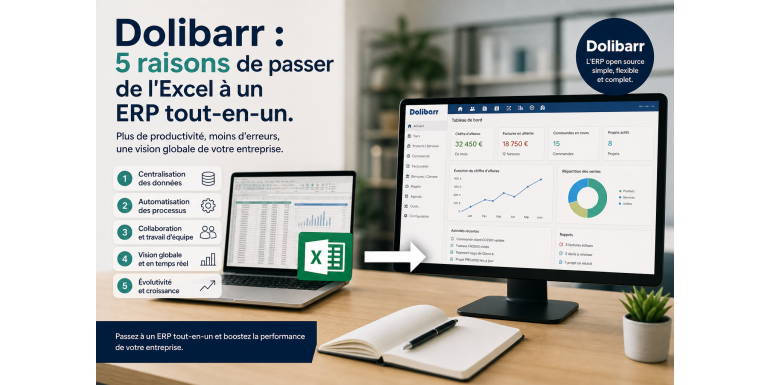
In an increasingly competitive and digital business environment, companies are constantly looking to improve productivity, organization, and decision-making capabilities. For years, Microsoft Excel has been the go-to tool for managing data, tracking sales, controlling inventory, and organizing finances. However, as business operations grow, Excel quickly reaches its limits. Human errors, file duplication, lack of real-time collaboration, and absence of automation become major obstacles to growth. This is where modern ERP systems like Dolibarr ERP CRM emerge as essential alternatives. This article explores in depth the five main reasons why businesses should move from Excel to an all-in-one ERP like Dolibarr, highlighting the tangible benefits for management, productivity, and overall performance.
2. Understanding the Limitations of Excel in Business Management
Excel is a powerful tool, but it was never designed to manage all business processes. At the beginning, it may be sufficient for tracking a few clients or managing a small inventory. However, as the company grows, files multiply, versions become inconsistent, and errors appear. Data is often duplicated across multiple spreadsheets, significantly increasing the risk of mistakes. Additionally, Excel does not support efficient real-time collaboration without additional tools, nor does it provide advanced access control. It becomes difficult to track who modified what, when, and why. Finally, Excel does not easily allow automation of complex business processes such as invoicing, order management, or payment tracking. These limitations drive many companies to look for more structured solutions.
3. Why an ERP Becomes Essential in 2026
In 2026, digital transformation is no longer optional but mandatory. Businesses must be able to centralize data, automate processes, and access real-time information to remain competitive. An all-in-one ERP meets these needs by offering a single platform that integrates all key business functions. Unlike Excel, an ERP is designed to structure data, ensure consistency, and facilitate data usage. It becomes a strategic tool for managing operations, anticipating risks, and seizing opportunities. Dolibarr stands out for its ease of use, modularity, and accessibility, making it an ideal solution for SMEs.
4. Reason 1: Data Centralization and Error Reduction
One of the main advantages of moving from Excel to Dolibarr is data centralization. With Excel, information is often scattered across multiple files, making management complex and error-prone. With an ERP, all data is stored in a single database. This eliminates duplicates, inconsistencies, and data loss. Centralization also facilitates access to data for authorized users, improving collaboration and transparency. Additionally, ERP systems include automatic controls that reduce data entry errors and ensure data quality. This reliability is essential for making informed decisions.
5. Reason 2: Business Process Automation
Excel relies heavily on manual operations, making processes slow and error-prone. In contrast, Dolibarr allows automation of many repetitive tasks. For example, invoices can be automatically generated from orders, payments can be tracked in real time, and customer reminders can be scheduled automatically. This automation saves significant time and reduces workload for teams. It also standardizes processes, ensuring better quality and consistency in task execution.
6. Reason 3: Improved Collaboration and Teamwork
In an Excel-based environment, collaboration is often challenging. Files must be shared via email or external tools, leading to version conflicts and data inconsistencies. With Dolibarr, all users work on a single platform accessible online. This enables real-time collaboration with full visibility into data and user actions. Additionally, the ERP allows advanced access control, ensuring that each user only sees relevant information. This structure improves internal communication and enhances team efficiency.
7. Reason 4: Global Visibility and Real-Time Monitoring
Excel does not provide a comprehensive and real-time view of business activities. Data must be manually compiled, which is time-consuming and prone to errors. With Dolibarr, dashboards and reports are automatically generated from real-time data. Managers can monitor commercial, financial, and operational performance at a glance. This visibility allows quick responses to market changes and better strategic decisions, providing a significant competitive advantage.
8. Reason 5: Scalability and Business Growth
One of Excel’s major limitations is its lack of scalability. As the business grows, spreadsheets become increasingly complex and difficult to manage. Dolibarr, on the other hand, is designed to grow with the company. Thanks to its modular architecture, new features can be added as needed. Whether managing a new department, integrating a specific module, or connecting the ERP to other tools, Dolibarr offers unmatched flexibility. This adaptability enables businesses to support growth without changing systems.
9. Direct Comparison: Excel vs Dolibarr
Excel is a powerful calculation tool, but it remains limited for overall business management. Dolibarr offers a complete solution that covers all business processes. Where Excel requires manual input, Dolibarr automates tasks. Where Excel scatters data, Dolibarr centralizes it. Where Excel limits collaboration, Dolibarr enhances it. This comparison clearly demonstrates the value of switching to an ERP for improved efficiency and performance.
10. Impact on Productivity and Profitability
Switching from Excel to Dolibarr has a direct impact on productivity. Repetitive tasks are automated, errors are reduced, and processes are optimized. Teams can focus on higher-value activities, improving overall profitability. Furthermore, better data management helps identify improvement opportunities and supports smarter decision-making.
11. Security and Access Management
Data security is a major concern for businesses. Excel does not offer advanced mechanisms to protect sensitive information. Dolibarr, on the other hand, includes robust security features, with detailed access control and activity tracking. This protects data from unauthorized access and ensures its integrity.
12. Adaptation to SME Needs
Dolibarr is particularly well-suited for SMEs that require a simple, flexible, and cost-effective solution. Unlike complex and expensive ERP systems, Dolibarr offers quick implementation and high modularity. It enables businesses to benefit from ERP capabilities without heavy constraints.
13. Return on Investment
Moving to an ERP represents an investment, but the benefits quickly become evident. Productivity gains, error reduction, and improved management lead to rapid return on investment. Additionally, as an open-source solution, Dolibarr offers excellent value for money.
14. Real-World Use Case
Many companies that have migrated from Excel to Dolibarr report significant improvements in organization. Processes become more structured, data becomes more reliable, and internal communication improves. These results highlight the importance of adopting an ERP to support business growth.
15. Conclusion
Moving from Excel to an ERP like Dolibarr is a strategic step for any company aiming to improve management and performance. The five reasons presented in this article clearly demonstrate the benefits of such a transition. By centralizing data, automating processes, enhancing collaboration, providing global visibility, and supporting growth, Dolibarr stands out as a must-have solution in 2026.