
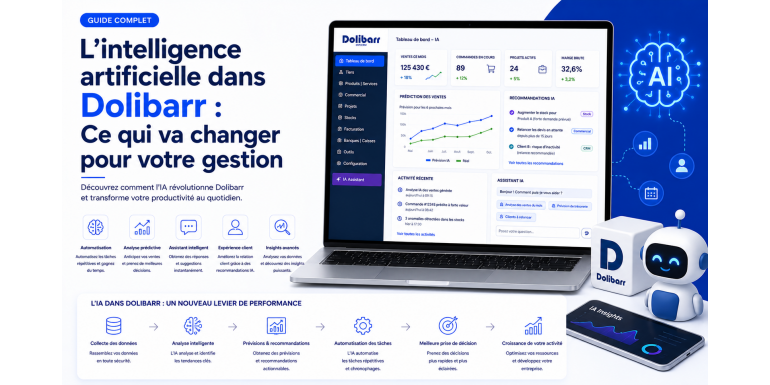
For years, artificial intelligence remained a topic reserved for large companies and research labs. It is now entering the daily lives of SMEs and is profoundly changing the way we manage a business. Dolibarr ERP/CRM, true to its vocation as an open and accessible tool, has integrated several AI building blocks in recent years that concretely transform productivity, service quality, and decision-making.
This transformation is not about replacing humans, but about automating repetitive tasks, augmenting analyses, and accelerating operations. In this article, NEXT GESTION presents in detail what AI brings to Dolibarr today, what it will bring tomorrow, how to enable it in your instance, and most importantly how to use it responsibly. Whether you are a small business owner, CFO, sales manager, or integrator, you will find here the keys to seize this major opportunity.
Table of Contents
- Why AI is coming to ERP/CRM
- Overview of AI features in Dolibarr
- Document recognition (OCR) for supplier invoices
- Automatic generation of commercial content
- Forecasting and predictive analytics
- Customer scoring and intelligent segmentation
- Integrated conversational assistant
- Automation of repetitive tasks
- Email writing assistance
- Intelligent categorization
- Anomaly and risk detection
- AI and accounting
- AI and project management
- AI and human resources
- AI and production / MRP
- Choosing your AI provider
- Sovereignty and data protection
- Cost and return on investment
- How to get started with AI in Dolibarr
- Limits and best practices
- Conclusion
- FAQ
1. Why AI is coming to ERP/CRM
The arrival of artificial intelligence in ERP/CRM systems is part of a fundamental trend. Language models (LLMs), image recognition systems, and predictive algorithms are now accessible via standardized APIs at costs compatible with SME needs. Three forces converge to drive this adoption.
First, technological maturity. Current models understand natural languages, read complex documents, and reason with reliability never before achieved. They have become usable without extensive technical expertise.
Then, economic pressure. Companies seek to do more with less. Automating the entry of a supplier invoice, automatically classifying a support ticket, generating the first version of a commercial proposal: all immediate gains that translate into hours saved each week.
Finally, employee expectations. New collaborators accustomed to ChatGPT, Copilot, or Gemini in their daily lives expect to find the same comfort in their professional tools. An ERP that does not offer AI quickly seems outdated.
Dolibarr seized this opportunity by progressively integrating AI in its recent versions, without compromising its open source philosophy or data sovereignty.
2. Overview of AI features in Dolibarr
Today, AI in Dolibarr covers several categories of use:
- Document recognition (OCR) to automatically extract data from received invoices, quotes, and delivery notes.
- Content generation to write product descriptions, sales emails, or general terms and conditions.
- Predictive analysis to anticipate sales, stock outages, and risk of unpaid invoices.
- Automatic categorization to classify tickets, accounting entries, opportunities.
- Conversational assistant to query your data in natural language.
- Anomaly detection to spot unusual behaviors (fraud, data entry errors, stock drift).
- Decision support via contextual recommendations in management screens.
These functions are available via native modules or extensions from the Dolistore, and generally rely on external models (OpenAI, Mistral, Anthropic, Google) or self-hosted ones (Llama, local Mistral, Ollama). The choice of provider depends on your cost, performance, and sovereignty constraints.
3. Document recognition (OCR) for supplier invoices
This is probably the most profitable and immediate AI use case in Dolibarr. Companies receive supplier invoices in PDF or paper format daily. Manual entry of these documents is time-consuming and error-prone.
The intelligent OCR integrated into Dolibarr now enables this operation to be automated. It works in several stages:
- The invoice is deposited in Dolibarr (by email, drag and drop, or via a dedicated mailbox).
- The document is analyzed by an AI engine that identifies the supplier, date, invoice number, pre-tax and total amounts, VAT rate, detailed lines.
- A supplier invoice record is automatically pre-filled.
- The user validates or corrects the information in seconds.
The gains are significant: according to our customer feedback at NEXT GESTION, the time to enter a supplier invoice goes from 3-5 minutes to 30-45 seconds. For an SME processing 200 invoices per month, this represents nearly 10 hours of data entry saved each month.
Several refinements are possible: automatic recognition of the accounting account based on the supplier's history, matching with a purchase order or delivery note, duplicate detection, alert in case of price discrepancy compared to a previous purchase.
4. Automatic generation of commercial content
Generative AI excels at writing standardized commercial content. Dolibarr leverages this capability in several use cases.
Product descriptions
When creating a product record, an assistant can suggest a short and long description from a few keywords. The description is consistent with your editorial guidelines, optimized for SEO if you sync with an e-commerce platform, and adapted to your target audience (B2B, B2C, technical, general public).
Commercial proposals
From a brief outline (client, need, budget), AI generates a first version of a commercial proposal. The salesperson then takes back control to adjust, personalize, and add their customer knowledge. The time saving is massive: a proposal that took two hours can be delivered in thirty minutes.
General terms and legal mentions
AI helps draft or update general terms and conditions of sale, legal mentions on quotes and invoices, and clauses specific to a market. Caution: a lawyer should always validate these documents for critical subjects.
Marketing communications
For prospecting emails, newsletters, and new product announcements, AI generates several variants that you can test (A/B testing). It adapts the tone (professional, warm, expert) according to the context.
5. Forecasting and predictive analytics
Predictive AI transforms planning in Dolibarr.
Sales forecasting
From the history of orders, seasonal patterns, ongoing commercial actions, and macroeconomic trends, models can forecast revenue for the coming months with increasing accuracy. Sales managers have an objective tool to drive their teams.
Stock outage anticipation
AI cross-references sales data, supplier lead times, ongoing orders, and seasonality to identify products at risk of running out of stock. An alert is generated well before the classic minimum threshold, allowing more peaceful replenishment.
Risk of non-payment
From past payment behaviors, public financial information, and economic conditions, AI can estimate the probability of non-payment of an outstanding invoice. This allows prioritizing reminders and avoiding bad surprises.
Cash flow forecasting
By consolidating ongoing orders, issued invoices, supplier invoices to be paid, banking deadlines, and historical delays, AI provides a 30, 60, 90-day cash flow projection more reliable than traditional methods. For SME CFOs, it is a precious asset.
6. Customer scoring and intelligent segmentation
AI helps to better understand and segment your customer portfolio.
Prospect scoring
From available data (company size, sector, browsing behavior if you track an e-commerce store, previous exchanges), AI assigns a qualification score to each prospect. Your salespeople focus their efforts on the most promising opportunities.
Customer churn risk detection
AI analyzes weak signals: drop in purchase frequency, slowdown in payments, increased support requests, opening of negative tickets. It alerts the relevant salesperson who can intervene before the customer leaves.
Cross-sell and up-sell opportunity identification
By analyzing the purchases of customers similar to yours, AI suggests complementary products likely to interest a particular customer. This approach, already common in e-commerce, becomes accessible to B2B sales teams.
Dynamic segmentation
Rather than fixed segments (by revenue, by sector), AI builds dynamic behavioral segments that evolve based on actual purchases. It sometimes reveals relevant groupings that would not have emerged from a classic analysis.
7. Integrated conversational assistant
This is the most visible and impressive evolution. Dolibarr now offers a conversational assistant capable of answering complex questions about your data in natural language.
A few examples of possible questions:
- "Who are my top 10 customers in the last quarter?"
- "How many invoices are still unpaid more than 30 days late?"
- "Which product has progressed best this year compared to last year?"
- "List me the orders from customer X over €5,000 since January."
- "What is the average margin rate on category Y this month?"
The assistant queries the Dolibarr database in real time, reconstructs the context, formulates the answer, and can even propose a chart. For executives who do not master SQL or reporting screens, it is a revolution: information becomes accessible in seconds.
The assistant can also act: create a quote draft, add an event to the calendar, send a reminder email. This agentic dimension should be used with caution and human validation for sensitive actions.
8. Automation of repetitive tasks
Several manual and time-consuming tasks can now be automated by AI in Dolibarr.
Sorting and routing of incoming emails
Emails received in a sales or support inbox can be analyzed automatically: extraction of the actual subject, classification (quote request, complaint, technical question), assignment to the right collaborator, automatic creation of an opportunity or ticket in Dolibarr.
Pre-filling of contact records
When a new contact is created from an email or web form, AI can automatically complete the record: enrichment with public data (website, LinkedIn, sector, size), duplicate search, possible association with an existing third party.
Assisted entry
On complex entry screens (order, quote, project), AI can propose intelligent default values based on history: products frequently purchased together, customer's usual payment conditions, standard delivery times.
Generation of recurring tasks
AI can analyze your practices and suggest the automatic creation of recurring tasks: commercial follow-up 7 days after a quote sent, quality control one week after delivery, feedback request one month after intervention.
9. Email writing assistance
More discreet but very useful daily, the email writing assistant is now integrated in Dolibarr. It can:
- Suggest a quick reply to an incoming email using the third party's context.
- Propose a rephrasing of an email written too sharply or too long.
- Adapt the tone to your interlocutor (formal, informal, technical, commercial).
- Translate an email into your customer's language.
- Generate personalized reminder emails based on the number of days late and customer relationship.
For salespeople who spend a lot of time on correspondence, this gain is considerable. And for teams working internationally, the translation function removes a major barrier.
10. Intelligent categorization
Manual categorization of masses of information is one of the most repetitive and least rewarding tasks. AI provides an effective response.
Support ticket categorization
An incoming ticket is analyzed and automatically classified by domain (technical, commercial, accounting), urgency level, incident type. It is routed to the right agent and its history is recalled.
Accounting entry categorization
When importing bank data or entering purchases, AI suggests the right accounting account based on history: "the last invoice from this supplier was charged to 6064, I propose the same allocation". The accountant just needs to validate.
Opportunity categorization
Sales opportunities are classified by probability of winning, maturity stage, need typology. The pipeline becomes more readable and actionable.
Product categorization
For large catalogs, AI can propose a coherent category tree, place new products in the right branches, and identify duplicates or incomplete records.
11. Anomaly and risk detection
AI is particularly effective at spotting what is out of the norm. Several use cases exist in Dolibarr.
Fraud detection
On supplier invoices, AI can flag suspicious invoices: unexpected change of bank details, unusual amount compared to the supplier's profile, label close to a known supplier but subtly different (phishing technique). It does not replace internal control but constitutes an additional layer of vigilance.
Data entry error detection
A misplaced comma, an incorrect VAT rate, a non-existent product reference: AI detects these inconsistencies before validation and proposes the correction.
Stock drift
If stock movements show an unusual pattern (abnormally numerous outflows on a reference, recurring discrepancies during inventories), AI alerts. It is a precious tool for anticipating losses or internal fraud.
Accounting anomalies
Continuous analysis of entries can reveal anomalies (unusually busy account, VAT discrepancy, forgotten reconciliation). These alerts are reported to the accountant for investigation.
12. AI and accounting
Accounting is one of the areas where AI brings the most value in Dolibarr.
Beyond invoice recognition and categorization, AI now assists bank reconciliation: it proposes correspondences between bank lines and accounting entries with a success rate above 90%. The accountant validates in minutes what previously took half a day.
AI can also explain a discrepancy between two periods ("the margin is lower in April than in March: this is mainly due to an exceptional commercial discount granted to customer X"), predict the tax bundle several weeks before closing, or suggest optimizations (forgotten deductible expenses, applicable tax credits).
For accounting firms using Dolibarr for their clients, AI is a major productivity multiplier.
13. AI and project management
In Dolibarr's Projects module, AI brings several precious aids:
- Workload estimation for a new project from similar past projects.
- Drift detection of budget or schedule in real time.
- Reallocation suggestions when a member is overloaded.
- Generation of progress reports customized for clients or management.
- Risk identification (probable overruns, critical dependencies, announced member departures).
For service companies and agencies, these features considerably improve project profitability and customer satisfaction.
14. AI and human resources
The HR module also benefits from AI, with particular precautions related to data sensitivity.
AI can analyze incoming CVs and match them with job descriptions. It can identify missing skills in a team relative to strategic objectives. It can synthesize annual reviews and reveal trends by department or site.
On the other hand, AI must never make critical decisions alone (recruitment, dismissal, raise). GDPR and best practices require a human decision for these sensitive subjects. AI is a decision support tool, not a decision maker.
15. AI and production / MRP
For industries using Dolibarr's MRP module, AI brings several performance levers.
Manufacturing order optimization
AI can schedule manufacturing orders taking into account capacity constraints, material availability, customer deadlines, and changeover times. The result is more efficient planning, with less downtime.
Predictive maintenance
From machine usage data (operating hours, past breakdowns, vibrations if available), AI can predict probable breakdowns and trigger preventive maintenance before the incident. Unplanned stoppages are significantly reduced.
Visual quality control
Coupled with industrial cameras, AI can detect defects on finished products and alert in real time. This function requires specialized modules but is becoming accessible.
Material purchasing optimization
AI optimizes quantities to order by cross-referencing consumption history, negotiated prices, possible expiration dates, and quantity discount conditions.
16. Choosing your AI provider
Dolibarr does not provide AI models itself: it relies on external providers that you choose according to your constraints. The main options today:
General cloud providers
- OpenAI (GPT-4, GPT-5): reference for versatile models, mature ecosystem, high performance. Mainly hosted in the United States.
- Anthropic (Claude): very good reasoning quality, particular attention to ethics and safety. Hosting in the United States and Europe depending on offers.
- Google (Gemini): strong integration with the Google Workspace ecosystem.
- Microsoft (Azure OpenAI Service): allows access to OpenAI models via Azure, with possible European hosting and enterprise contractual compliance.
European providers
- Mistral AI (French): comparable quality models, hosting in Europe, ensured sovereignty. Available in cloud or self-hosted version.
- OVHcloud AI Endpoints: managed services in France to run open source models.
Self-hosted models
For companies subject to strict sovereignty constraints (health, defense, finance), it is now possible to run models locally via solutions like Ollama or vLLM, leveraging on-site GPUs or a private cloud. Performance is lower than the best cloud models but sufficient for most Dolibarr use cases.
The choice depends on the quality/cost/sovereignty triangle specific to your business.
17. Sovereignty and data protection
AI in Dolibarr raises legitimate questions about data protection. Here are the essential points.
What data is sent to the model?
For a model to process an invoice or answer a question, it must receive the corresponding content. This may include personal data (names, addresses, amounts), or even confidential data. You must decide what data is acceptable for what use.
GDPR and legal bases
The processing by AI of personal data must rest on a valid legal basis under GDPR: legitimate interest, contract execution, consent. Document these choices in your processing register.
Provider commitments
Verify the contractual commitments of the AI provider: non-use of data to train models, retention duration, server location, security certifications (ISO 27001, SOC 2). Enterprise offers from major providers are generally more protective than consumer offers.
Anonymization and minimization
Before sending data to an external model, it is often possible to anonymize or minimize it: remove real names, transmit only strictly necessary information. Dolibarr can be configured to apply these rules automatically.
Self-hosted models for sensitive data
For the most sensitive data, prefer self-hosted models or sovereign European providers. The extra cost can be justified by the criticality.
18. Cost and return on investment
AI has a direct cost (tokens consumed from the provider) and indirect cost (integration, training). The orders of magnitude, as of May 2026, are as follows.
For light usage (a few invoice OCRs per day, occasional writing assistance), expect €10 to €50 per month in API cost.
For moderate usage (systematic OCR, generation of product descriptions, customer scoring), expect €50 to €300 per month.
For intensive usage (active conversational assistant, massive automations, daily forecasts), expect €300 to €1,500 per month.
The return on investment is generally rapid. Some examples observed with our clients:
- Supplier invoice OCR saves about 8 hours per month for a volume of 200 invoices, or €200 to €400 depending on the hourly cost.
- Generation of commercial proposals saves 5 to 10 hours per week for a salesperson.
- The conversational assistant prevents an executive from soliciting their teams for ad hoc analyses.
Overall, ROI is most often between 3 and 12 months.
19. How to get started with AI in Dolibarr
Adopting AI in Dolibarr is a project to structure to avoid disappointments. Here is the approach NEXT GESTION recommends.
Identify priority use cases
Don't try to do everything at once. Identify the 2 or 3 use cases that will bring you the most immediate value. For most SMEs, these are supplier invoice OCR and commercial writing assistance.
Choose an AI provider
Select the provider based on the criteria mentioned (quality, cost, sovereignty). Test several models before committing: performance varies significantly by use case.
Configure Dolibarr
Activate the corresponding AI module in your Dolibarr version (V22 or V23 recommended), enter the provider's API key, adjust the parameters (language, tone, models used per function).
Test in pre-production
Always test on an anonymized copy of your database before production. Validate the quality of results on a representative sample.
Train users
AI is only useful if it is used. Organize training sessions for your teams, explain best practices (formulating clear prompts, systematically validating results), and limits.
Measure and adjust
Track performance indicators: time saved, suggestion acceptance rate, perceived quality by users. Adjust parameters over time.
20. Limits and best practices
AI in Dolibarr is powerful, but it has its limits. A few essential best practices.
Always validate results
AI can be wrong. A poorly read invoice, an erroneous accounting category, an optimistic forecast: these errors are rare but possible. Systematically put human validation on important actions.
Don't entrust AI with critical decisions
Recruitment, dismissal, credit granting, strategic choices: these decisions must remain human. AI can inform but should not decide alone.
Audit regularly
Keep a log of AI-assisted decisions. This allows you to roll back, identify potential biases, and respond to GDPR audits.
Train and raise awareness
AI evolves quickly. Today's best practices may no longer be appropriate in six months. Invest in continuous training for your teams.
Keep humans at the center
AI is a tool at the service of humans, not the other way around. It frees up time on repetitive tasks to allow you to focus on what really creates value: customer relationship, innovation, strategy.
21. Conclusion
Artificial intelligence in Dolibarr is no longer a distant promise: it is an operational reality that is transforming the productivity of companies adopting it today. Invoice OCR, content generation, forecasting, conversational assistant, anomaly detection: all concrete levers to save time, improve service quality, and make better decisions.
For VSEs and SMEs, it is the opportunity to level the playing field with large enterprises: analytical and automation capabilities once reserved for Fortune 500 companies are now accessible at a reasonable cost. For integrators, it is a new dimension of added value: configure, parameterize, train.
At NEXT GESTION, we support companies in integrating AI into their Dolibarr: selection of use cases, choice of provider, technical configuration, team training, ongoing support. Our approach is pragmatic: start small, measure benefits, expand progressively.
Want to explore what AI can bring to your Dolibarr? Contact us at contact@nextgestion.com for a free audit. We will identify with you the most profitable use cases for your activity and propose a tailored adoption plan.
22. FAQ: AI in Dolibarr
From which version of Dolibarr is AI available? The first AI building blocks appeared from V22, with major developments in V23. Some functions are also available via third-party modules compatible with earlier versions.
Does AI in Dolibarr replace jobs? No. It automates low-value-added repetitive tasks and frees up time for high-value missions (customer relationship, analysis, strategy). The goal is the augmentation of collaborators, not their replacement.
Is my data shared to train models? It depends on the provider and the chosen offer. Enterprise offers from major providers contractually guarantee non-use of data for training. Read the terms carefully before committing.
Can a 100% French or European model be used? Yes. Mistral AI offers competitive models hosted in Europe. Self-hosted models via Ollama even allow total control. Sovereignty is no longer an obstacle.
How much does AI in Dolibarr cost? From a few tens to several thousand euros per month depending on usage. ROI is generally achieved in 3 to 12 months for the most profitable use cases.
Do you need an expert to configure AI in Dolibarr? Not for basic functions, which can be activated with an API key. For advanced use cases (custom models, complex automations), support from an integrator is recommended.
Does AI work in French? Yes, perfectly. Modern models master French at a native level. Still, verify the quality on a few samples before going to production.
What happens if the AI provider is down? Dolibarr continues to function normally, only AI functions are temporarily unavailable. For critical uses, plan for a backup provider.
Article written by NEXT GESTION, expert in Dolibarr ERP/CRM integration and consulting. To explore the contributions of AI to your activity, contact us at contact@nextgestion.com.